
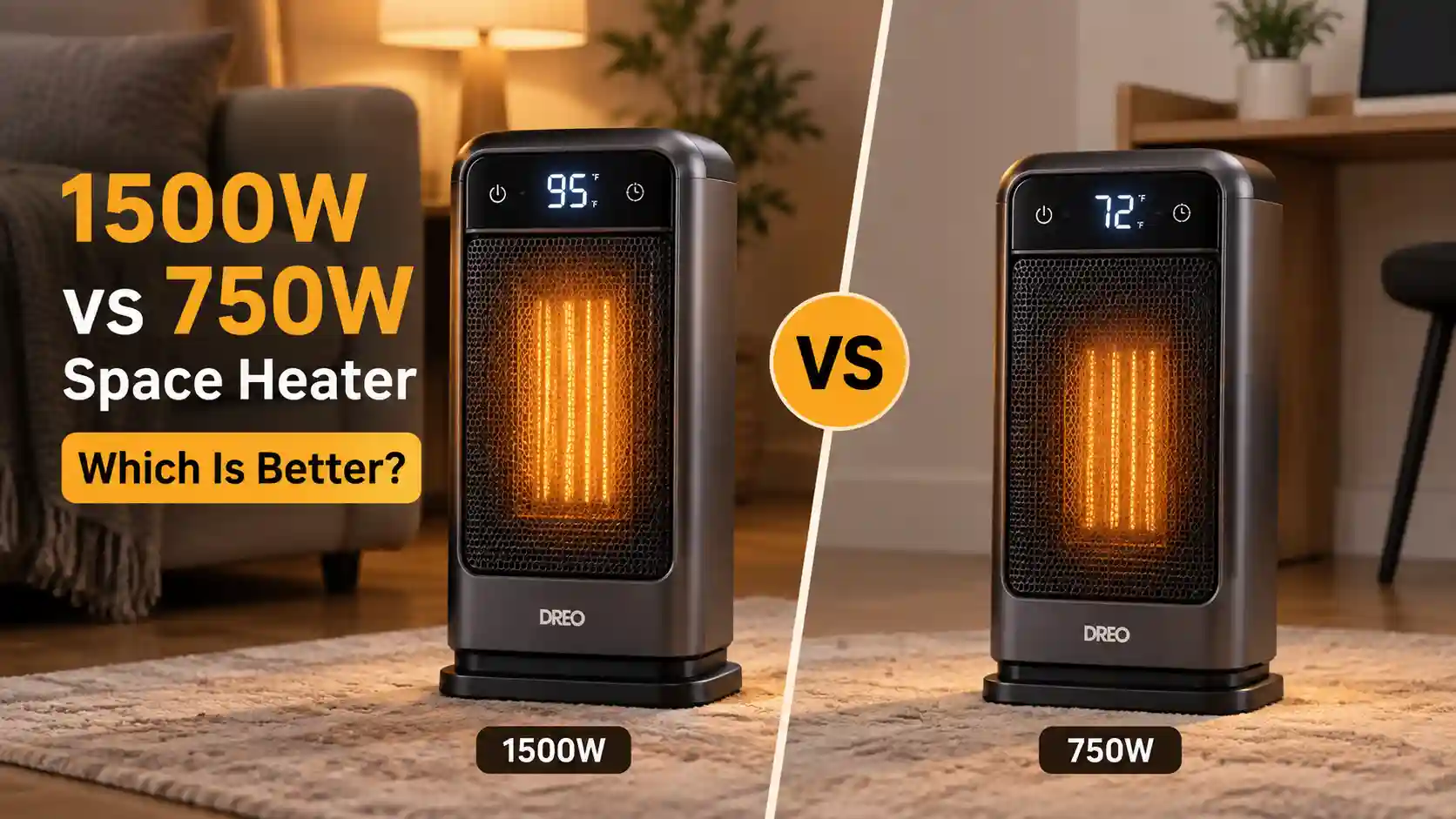

A 1,500W space heater produces about twice the heat of a 750W setting, but it also draws about twice the electrical power while running. On a 120V supply, 1,500W is about 12.5 amps and 750W is about 6.25 amps.
Choose 750W for personal heat, a very small occupied area, or when lower circuit load matters. Choose 1,500W when you need faster warm-up or more room-level heat. Many portable heaters include both settings, so the best option is often a heater that lets you switch between them.
Paid link. As an Amazon Associate, we earn from qualifying purchases at no extra cost to you.
TL;DR
- 1,500W gives roughly twice the heat output of 750W while both are running.
- 750W uses half the power per hour, but a lower setting may need to run longer to reach the same comfort level.
- At 120V, 1,500W is about 12.5A; avoid combining it with other heavy loads on the same circuit.
- For room sizing, use wattage as a starting point, then account for insulation, ceiling height, windows, and manufacturer coverage guidance.
1500W vs 750W Space Heater: Quick Comparison
| Factor | 1500W | 750W |
|---|---|---|
| Power at full setting | 1.5 kW | 0.75 kW |
| Approx. current at 120V | 12.5A | 6.25A |
| Approx. heat output | 5,118 BTU/h | 2,559 BTU/h |
| Best use | Faster room-level supplemental heat | Personal heat / lower-load use |
| Cost at $0.18/kWh | $0.27/hour | $0.14/hour |
Does 750W Actually Save Electricity?
Per hour, yes: 750W uses half the electricity of 1,500W. But lower wattage does not automatically mean lower total energy use for the same heating job. If a 750W setting must run twice as long as a 1,500W setting, total energy consumption can be similar.
Use this formula: kilowatts × hours × electricity rate = operating cost. At $0.18/kWh, 1,500W costs about $0.27 per active hour and 750W about $0.135 per active hour. For the electricity and running-cost side of this topic, see How Many Watts Does a Space Heater Use.

Which Setting Heats a Room Better?
For ordinary portable resistance heaters, more wattage means more heat output. A 1,500W setting therefore warms a cold occupied room faster than 750W, assuming the heaters distribute heat similarly.
A common rough sizing rule is about 10 watts per square foot under average conditions, putting 1,500W near a 150-square-foot starting point. That is not a guaranteed coverage rating. Insulation, drafts, ceiling height, windows, and outdoor temperature can change the result significantly. See our 1,500W heater room-size guide.
Circuit Load: 1500W vs 750W
A 1,500W heater is a heavy load on a 120V household circuit. Its approximate 12.5A draw leaves much less room for other high-wattage devices than a 750W setting. If a breaker trips, an outlet gets hot, or a plug shows discoloration, stop using the setup and investigate the electrical issue. For more on energy use and running costs, see how many watts does a space heater use.
Do not treat 750W as a way to make a damaged outlet safe. A loose, hot, discolored, buzzing, or burnt-smelling outlet needs attention regardless of heater setting. See our guides to breaker trips and a hot heater plug or outlet.
When to Use 1500W
- You need faster warm-up in an occupied room.
- The room is around the normal 1,500W supplemental-heating range and the manufacturer supports that use.
- The heater is connected directly to a suitable wall outlet and the circuit is not being overloaded by other heavy appliances.
- You plan to let the thermostat cycle the heater rather than run high continuously.
When to Use 750W
- You mainly want personal heat at a desk or chair.
- The room is already moderately warm and you only need a small comfort boost.
- You want lower instantaneous power draw on an otherwise suitable circuit.
- You are maintaining comfort after a higher setting has already warmed the space, if the heater manual supports that operating mode.
Safety Is More Important Than Wattage
CPSC recommends plugging portable electric heaters directly into a wall outlet, keeping them at least three feet from combustible materials, and turning them off when sleeping. These rules apply whether you are using a 750W or 1,500W setting. See the CPSC heater safety guidance.
1500W vs 750W: Which Should You Choose?
If your priority is faster room heating, choose 1,500W. If your priority is personal warmth or lower instantaneous power draw, 750W can be enough. A dual-setting heater gives you both options and lets you match output to conditions instead of choosing one wattage permanently.

Frequently Asked Questions
Does a 1500W heater always use twice as much electricity as 750W?
While both settings are actively running, 1,500W uses twice the power. Total daily energy depends on runtime and thermostat cycling.
How many amps does a 1500W heater use?
At 120V, 1,500W is approximately 12.5 amps. At the same voltage, 750W is approximately 6.25 amps.
Is 750W safer than 1500W?
It draws less current, but wattage alone does not make a heater safe. Correct placement, a sound outlet, direct wall connection, functioning safety features, and supervision remain essential.
Can I run a 750W heater while sleeping?
CPSC recommends turning portable heaters off when sleeping, regardless of the wattage setting.
Is 750W enough for a bedroom?
It may be enough for personal or supplemental warmth in mild conditions, but it is not a universal bedroom-size rating. Use the heater manufacturer’s coverage guidance and consider insulation and room size.


