
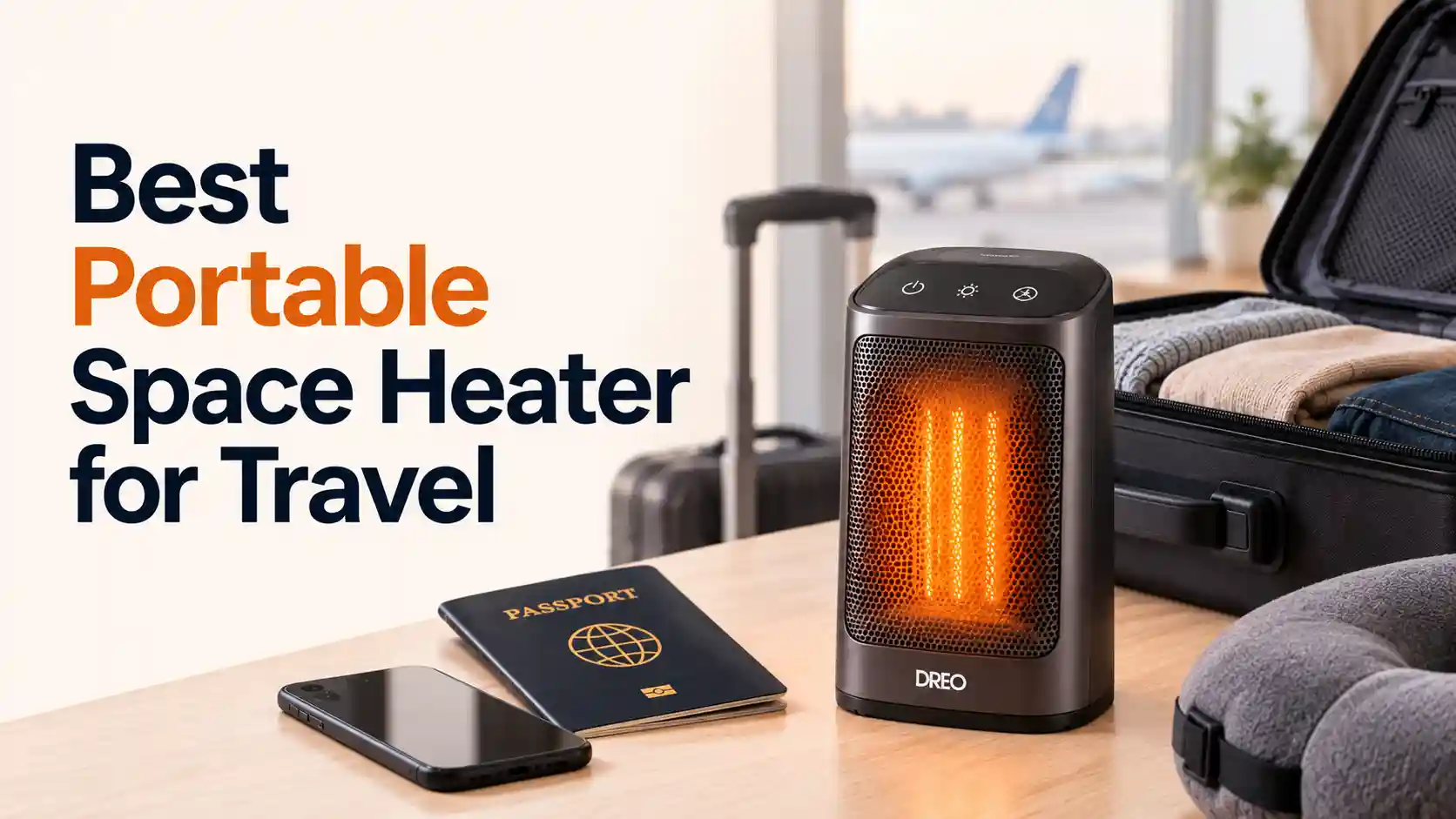


The best portable space heater for travel should be compact, easy to carry, appropriate for the outlet you will use, and equipped with safety features that make sense in an unfamiliar room. For most U.S. road trips, cabins, RV stops and hotel stays where personal heaters are permitted, a small electric ceramic heater is the most practical choice.
Travel changes the buying decision. A heater that works perfectly at home may be inconvenient on the road because of its weight, power draw, voltage requirements or room rules. Before packing any travel space heater, check the accommodation policy, the heater’s voltage label and the available electrical circuit.
Paid link. As an Amazon Associate, we earn from qualifying purchases at no extra cost to you.
TL;DR
- Dreo Atom One is the strongest all-around pick for domestic travel when you want a thermostat, remote, timer, oscillation, tip-over protection and overheat protection in a compact body.
- Amazon Basics 500W Mini is a better fit when size and lower power draw matter more than whole-room heating.
- Vornado VH204 is designed for personal heating and includes tip-over/heat-overload protection in a compact format.
- For international trips, do not assume a plug adapter makes a 120V heater compatible with 220–240V power. Match the heater to the destination voltage.
This post contains affiliate links. We may earn a commission if you buy through them. As an Amazon Associate we earn from qualifying purchases.
Best Portable Space Heaters for Travel: Quick Picks
| Heater | Best For | Why It Works for Travel |
|---|---|---|
| Dreo Atom One | Best overall | Compact 3.8 lb body, thermostat, remote, timer, oscillation and documented tip-over/overheat protection |
| Amazon Basics 500W Mini | Desks and personal heat | Very small, lightweight and only 500W |
| Vornado VH204 | Low-energy personal heat | Current personal-heater design with two heat settings, fan-only mode and tip-over/heat-overload protection |
| GiveBest Portable Heater | Simple dual-power option | Compact ceramic design with 1500W/750W modes and portable carry handle |
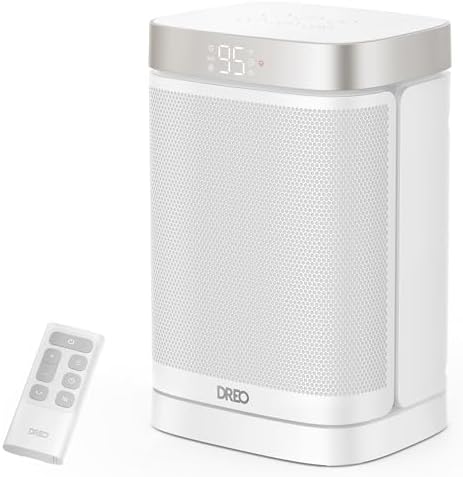


Dreo Atom One: Best Overall Travel Space Heater
The Dreo Atom One is my strongest all-around portable heater for hotel and road-trip use when the property allows personal heaters. Dreo lists a 120V power supply, a 900–1500W wattage range, a 41–95°F thermostat, 70° oscillation, a 1–12 hour timer and a 3.8 lb product weight. It also includes tip-over and overheat protection.

The advantage is control. You can use lower heat when full output is unnecessary, set a target temperature and use the timer instead of running a basic heater continuously. If you want the model-specific breakdown, read our Dreo Atom One review.
Amazon Basics 500W Mini: Best Ultra-Compact Pick
If your priority is a small space heater for travel, the Amazon Basics 500W Mini is easier to pack than a full-size 1500W heater. The current listing describes a 500W ceramic heater weighing about 1.4 lb with tip-over protection. That makes it better for warming the area around a desk or chair than heating an entire hotel room.
The trade-off is limited control. This is a simple personal heater rather than a thermostat-driven whole-room model. See our Amazon Basics 500W Mini heater review or our best 500W space heaters guide for more context.
Vornado VH204: Best for Personal Travel Heat
Vornado currently positions the VH204 as a personal heater for desktop, tabletop and under-desk use rather than a whole-room heater. It has two heat settings plus fan-only mode, a compact footprint, tip-over protection, heat-overload protection and a cool-touch cabinet. That combination makes it a sensible option when you want personal warmth without carrying a larger tower heater.
Because it is designed around personal heating, do not expect it to replace central heat in a large rental room. Check the current Vornado VH204 product page for the exact version and instructions before travel.
GiveBest Portable Heater: Best Simple Dual-Power Option
The GiveBest portable ceramic heater remains a practical budget option if you want a small carry-handle design with 1500W and 750W heat modes. The current product data also lists overheat and tip-over protection. The 750W setting can be useful when you need less heat, but you still need to make sure the circuit can safely support the heater and any other appliances being used.
What About the Lasko 754200?
The Lasko 754200 is compact and inexpensive, but I would not make it the first choice for travel. Lasko’s current product page lists 1500W high heat, 900W low heat, adjustable thermostat control, overheat protection and a cool-touch housing, but it also lists no auto shut-off. For a heater that may be used in unfamiliar rooms, I prefer models with documented tip-over shutoff.
How to Choose the Best Portable Space Heater for Travel
1. Check the Accommodation Rules
Hotels, rentals, dorm-style accommodations and campsites can have their own rules about personal heating appliances. Check before arriving rather than assuming a portable electric heater is allowed.
2. Match the Heater to the Available Voltage
The Dreo Atom One and Lasko 754200, for example, are current 120V products. Many international destinations use approximately 220–240V mains power. A plug-shape adapter does not convert voltage. Unless the heater explicitly supports the destination voltage, use a locally compatible heater instead.
3. Consider Wattage and Circuit Load
A 1500W heater draws about 12.5 amps on a 120V circuit at full output. That is a significant load, especially in an RV or older room where other devices may share the circuit. A 500W or lower-output personal heater produces less heat but also places less instantaneous demand on the circuit.
4. Prioritize Tip-Over and Overheat Protection
Travel rooms are unfamiliar, and luggage, bedding and furniture can make placement harder. I prefer a travel space heater with both tip-over and overheat protection. Safety features do not replace careful placement, but they add another layer of protection.
5. Keep Size in Perspective
The smallest heater is not automatically the best heater. A tiny 500W model is convenient to pack but is mainly a personal heater. A compact 1500W model can provide more room heat but weighs more and places a much larger load on the outlet.
Travel Space Heater Safety Checklist
- Place the heater on a stable, level surface where airflow is not blocked.
- Keep it at least three feet from bedding, curtains, luggage, clothing and other combustible materials.
- Plug electric space heaters directly into a suitable wall outlet, not a power strip or ordinary extension cord.
- Turn the heater off before sleeping or leaving the room.
- Do not use a 120V-only heater on a higher-voltage supply with only a plug adapter.
- Stop using the heater if the plug, outlet or cord becomes unusually hot or damaged.
The U.S. Consumer Product Safety Commission recommends keeping portable heaters at least three feet from combustible materials, plugging electric heaters directly into a wall outlet and turning them off when sleeping. See the current CPSC heater-safety guidance.
Using a Portable Heater in an RV or Camper
RV electrical capacity deserves extra attention because a 1500W heater can consume a large share of a 120V branch circuit. If you are running a microwave, coffee maker, water heater or other high-draw appliance, you may not have much capacity left. A lower-watt personal heater can be easier to manage, but always follow the RV electrical limits. See our best space heaters for RVs and campers.
Can You Bring a Space Heater on a Plane?
Do not assume every airline or security authority treats portable heaters the same way. Before flying, check the current rules for your airline, departure airport and destination. Even when an electric heater contains no fuel, size, electrical construction and local screening rules can affect what is accepted.
For international trips, voltage compatibility is often the bigger practical problem. Buying or borrowing a locally compatible heater at the destination can be simpler than carrying a 120V appliance overseas.
Best Portable Space Heater for Travel: Verdict
For most domestic road trips and hotel stays where personal heaters are allowed, the Dreo Atom One is the best portable space heater for travel because it combines a compact body with a thermostat, remote, timer, oscillation, and documented tip-over and overheat protection.
If you want the smallest option for personal warmth, the Amazon Basics 500W Mini is easier to pack. If you prefer a current personal-heater design from Vornado, the VH204 is another strong option. For international travel, prioritize voltage compatibility and accommodation rules before choosing any heater.
Frequently Asked Questions
What is the best portable space heater for travel?
For most U.S. road travel where personal heaters are allowed, the Dreo Atom One is a strong overall choice because it combines compact dimensions with thermostat control, a timer, oscillation, remote control, tip-over protection and overheat protection.
Is a 500W heater better for travel?
A 500W heater is easier on the circuit and can be much smaller, but it produces less heat. It is best for personal warmth near a desk, chair or bedside area rather than whole-room heating.
Can I use a U.S. space heater in Europe with a plug adapter?
Not if the heater is 120V-only and the destination uses approximately 220–240V. A basic plug adapter changes the plug shape but does not convert voltage. Use a heater designed for the local electrical supply unless the appliance explicitly supports both.
Can I leave a travel heater on while sleeping?
No. CPSC guidance says to turn portable heaters off when sleeping. Keep the heater at least three feet from bedding and other combustible materials.
Is the Lasko 754200 a good travel heater?
It is compact and inexpensive, but Lasko’s current page lists no auto shut-off. For travel, I prefer models with documented tip-over shutoff as well as overheat protection.


