
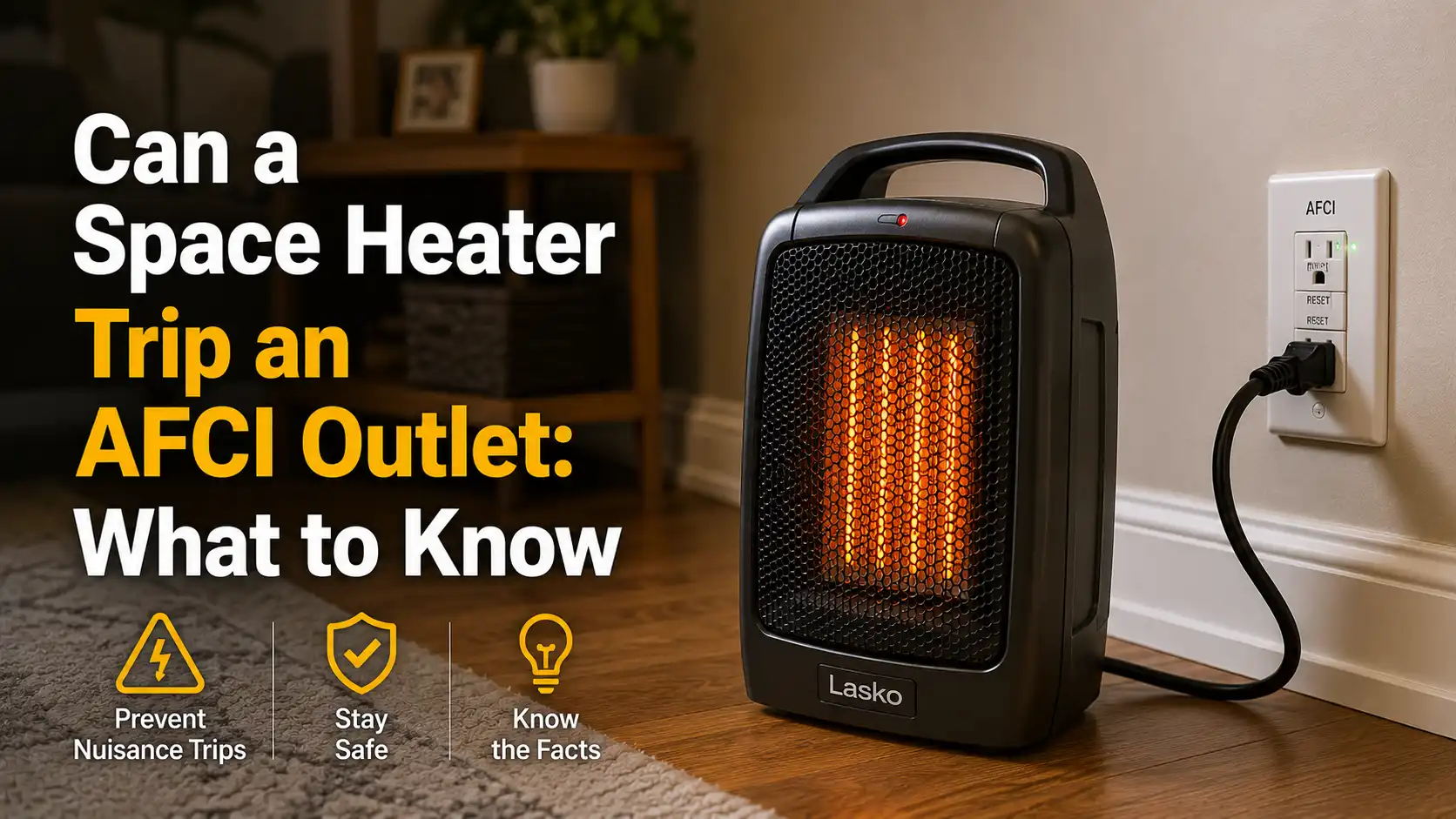


You are settling into your home office, ready for a productive morning. You plug in your favorite portable heater to take the chill off the room. Suddenly, with a sharp “click,” the power cuts out. You check the outlet, and the little reset button has popped out. You have just experienced a trip on an AFCI (Arc Fault Circuit Interrupter) outlet.
This is a common and deeply frustrating winter problem. You might worry that your heater is broken or that your house is in danger. If you have been asking Can a Space Heater Trip an AFCI Outlet, the answer is yes, but the reason why is often a mix of high-tech safety and simple physics. If this symptom or maintenance issue applies, Space Heater Keeps Tripping Breaker Common Causes and Fixes covers the likely causes and safe checks.
As an experienced reviewer of space heaters, I have seen these safety devices become more common in homes since 2026. They are designed to save lives, but they can be incredibly sensitive. Let’s look at why your heater is clashing with your home’s safety sensors and how you can stay warm without the constant power cuts.
Paid link. As an Amazon Associate, we earn from qualifying purchases at no extra cost to you.
TL;DR
- A space heater can trip an AFCI outlet or breaker for two main reasons: a legitimate safety hazard (like a loose wire sparking inside the unit) or a "nuisance trip." Nuisance trips happen when the AFCI's computer chip misinterprets the
- Keep a portable heater on a stable surface with about 3 feet (0.9 m) of clearance from bedding, curtains, furniture and other combustible materials.
- Plug portable electric heaters directly into a suitable wall outlet; stop using a heater if the plug, cord or outlet becomes unusually hot, damaged or discolored.
- Safety features reduce risk but do not replace correct placement, supervision and the manufacturer’s instructions.
Quick Answer: Space Heaters and AFCI Trips
A space heater can trip an AFCI outlet or breaker for two main reasons: a legitimate safety hazard (like a loose wire sparking inside the unit) or a “nuisance trip.” Nuisance trips happen when the AFCI’s computer chip misinterprets the normal electrical signature of a high-powered heater as a dangerous spark, causing it to shut off power as a precaution.

What is an AFCI and Why is it So Sensitive?
To understand the problem, you need to know what an AFCI actually does. Most people are familiar with GFCI outlets, which protect you from electric shocks in wet areas like bathrooms. An AFCI is different. Its job is to prevent electrical fires. For the related safety issue, our Can a Space Heater Damage Wall Outlets covers the specific risks and safer checks.
An AFCI contains a tiny, sophisticated computer. It constantly monitors the “shape” of the electricity flowing through the wires. It looks for “arcs”—tiny sparks that happen when a wire is frayed or a connection is loose. These arcs create intense heat that can start a fire inside your walls.
Because arcs are so dangerous, the AFCI is programmed to be extremely cautious. It is like a smoke detector for your electricity. However, because it is so sensitive, it sometimes gets “confused” by big, power-hungry appliances like space heaters.
1. Legitimate Safety Trips: The Real Danger
When you ask Can a Space Heater Trip an AFCI Outlet, your first thought should always be safety. Sometimes, the trip is a warning you should not ignore.
Frayed Cords and Loose Plugs
If your heater is several years old, the power cord might have internal damage. If you move the heater around a lot, the wires inside the cord can break. This creates a “series arc” where electricity jumps across the break. The AFCI sees this mini-lightning bolt and shuts everything down to prevent a fire.
Poor Internal Connections
Space heaters pull a massive amount of current, usually 1,500 watts. This creates heat, which causes metal parts inside the heater to expand and contract. Over time, a wire inside the unit can wiggle loose. This loose connection creates a small spark every time the heater cycles on, triggering the AFCI’s “fire prevention” logic.
2. Nuisance Tripping: When the “Wolf” is Fake
In many cases, the heater and the wiring are perfectly fine. This is called a nuisance trip. This is the most common complaint from homeowners using modern safety outlets.
High Power “Noise”
When a heater turns on, it creates a sudden surge of electricity. Some heaters also use fans with “brushed” motors. These motors naturally create tiny, harmless sparks as they spin. The AFCI outlet sees this electrical “noise” and misinterprets it as a house fire in the making. For more detail on this topic, see our guide to how to maintain a space heater for long life.
Incompatibility Issues
Older AFCI technology from a decade ago often struggles with modern, high-efficiency heaters. The algorithms in the outlet’s chip might not be updated to recognize the electrical signature of your specific heater. This is essentially a software conflict between your outlet and your appliance.
3. How to Identify the Cause of the Trip
Before you assume your heater is junk, follow these troubleshooting steps to find the root of the problem.
- The Visual Inspection: Unplug the heater and look at the cord. Is it cracked? Are the prongs on the plug discolored or bent? If the plug feels hot to the touch immediately after a trip, you likely have a bad connection.
- The “Other Outlet” Test: Take the heater to a room that does not have an AFCI outlet (like an older kitchen or a garage). If it runs perfectly there for an hour, the heater is likely safe, and you are dealing with a nuisance trip or a sensitive outlet.
- The Load Test: Is anything else plugged into that same circuit? A space heater uses almost 100% of a standard 15-amp circuit’s capacity. If a lamp or computer is on the same line, the AFCI might trip due to a simple overload rather than an arc.
5. Safety Considerations: When to Call a Pro
Electricity is not a DIY project for beginners. You should call a licensed electrician if you notice any of the following:
- Burning Smells: If you smell ozone or burnt plastic near the outlet or the panel.
- Charred Outlets: If the plastic around the outlet holes looks discolored or melted.
- Repeated Trips with Nothing Plugged In: If the AFCI trips even when the heater is unplugged, the problem is inside your walls, which is a major fire risk.
- Buzzing Sounds: If you hear a faint sizzling or buzzing sound coming from the wall when the heater is running.
Practical Tips
- Plug it All the Way In: It sounds simple, but a half-plugged-in heater is the #1 cause of arcing. Ensure the prongs are fully seated in the outlet.
- Avoid Extension Cords: Never use an extension cord with a space heater. They add resistance and “noise” that will almost always trip an AFCI.
- Keep it Clean: Dust inside a heater can cause tiny sparks. Use compressed air to blow out your heater’s intake once a month.
- Check the Breaker Brand: Some brands of AFCI breakers are known to be more “sensitive” than others. If you have a specific brand that trips constantly, an electrician may suggest a different manufacturer.
Common Mistakes to Avoid
One of the biggest mistakes is trying to “bypass” the AFCI by using a cheap adapter or a “cheater plug.” This removes your fire protection and is incredibly dangerous. The AFCI is tripping for a reason either your heater is noisy or your wiring is loose. Fixing the root cause is always better than ignoring the warning.
Another mistake is repeatedly resetting the outlet. If it trips three times in a row, stop. You are forcing electricity through a potential fire hazard. Finally, don’t use your heater on a “Low” setting and think you are safe from trips. Even on low, a heater draws enough current to trigger a sensitive AFCI if there is a wiring issue.

Frequently Asked Questions
Is it safe to reset an AFCI outlet every time it trips?
You can reset it once or twice to see if it was a fluke. However, if it trips repeatedly, stop using that outlet. Frequent tripping is a clear sign of either a faulty appliance or a dangerous wiring problem that needs to be fixed.
Why does my vacuum trip the AFCI but my heater doesn't?
Vacuums use “brushed” motors that create a lot of electrical sparks (arcs) as they spin. Some space heaters are “purely resistive,” meaning they just use a hot wire with no motor, which creates much less electrical noise for the AFCI to find.
Can I replace an AFCI outlet with a regular one?
In most modern homes, the building code requires AFCI protection in bedrooms and living areas. Replacing it with a standard outlet is a code violation and could make you liable if a fire occurs. It also removes a vital layer of fire safety.
Do infrared heaters trip AFCIs less often?
Generally, yes. Many infrared heaters do not use high-speed fans, or they use brushless motors that create less electrical noise. If you have a very sensitive AFCI system, an infrared unit might be a more stable choice.
How long do AFCI outlets last?
Most AFCI outlets and breakers have a lifespan of about 10 to 15 years. Like any computer-based device, the internal chips can wear out or become “glitchy” over time, leading to more frequent nuisance trips.
What is the difference between an AFCI and a GFCI?
A GFCI (Ground Fault) protects you from electrocution by detecting if electricity is leaking to water or your body. An AFCI (Arc Fault) protects your home from fire by detecting sparks and heat buildup in the wiring.
Does the "Test" button on my outlet fix the tripping?
No. The “Test” button is there to make sure the internal computer is still working. If you press it and the outlet doesn’t trip, the outlet is actually broken and must be replaced immediately to keep your home safe.


