
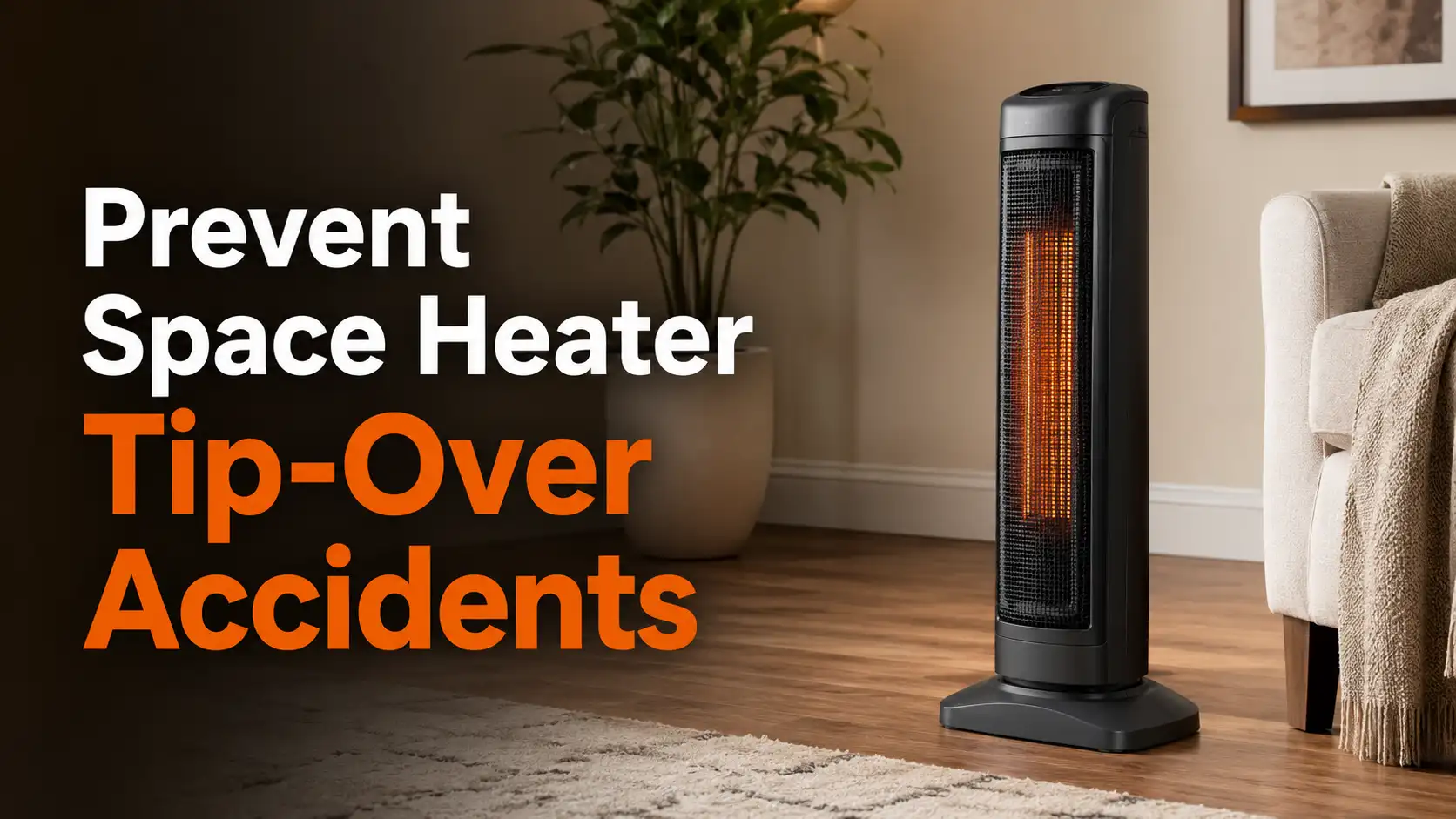


You are sitting on your sofa, enjoying the gentle warmth of your portable heater. Suddenly, your dog zooms across the room chasing a toy, or your toddler decides the heater looks like a perfect drum. In a split second, the heater is on its side against the rug. Your heart skips a beat. You know that a fallen heater is one of the leading causes of home fires during the winter.
This is a nightmare scenario for any homeowner. Space heaters are designed to push out intense heat, and when that heat is directed at a flammable carpet or curtain instead of the air, things go wrong fast. If you have been searching for how to prevent space heater tip over accidents, you are already taking the most important step in winter safety: being proactive.
As an experienced reviewer of heating technology, I have seen how quickly a minor stumble can turn into a major hazard. The good news is that preventing these accidents is mostly about smart placement and choosing the right gear. Let’s look at how to secure your “warm zone” so you can relax without the worry of a knock-over.
Paid link. As an Amazon Associate, we earn from qualifying purchases at no extra cost to you.
TL;DR
- To prevent space heater tip over accidents, always place your heater on a level, hard, non-flammable surface like tile or hardwood rather than carpet.
- Keep a portable heater on a stable surface with about 3 feet (0.9 m) of clearance from bedding, curtains, furniture and other combustible materials.
- Plug portable electric heaters directly into a suitable wall outlet; stop using a heater if the plug, cord or outlet becomes unusually hot, damaged or discolored.
- Safety features reduce risk but do not replace correct placement, supervision and the manufacturer’s instructions.
Quick Answer: Stopping Tip Over Risks
To prevent space heater tip over accidents, always place your heater on a level, hard, non-flammable surface like tile or hardwood rather than carpet. Keep the unit out of high-traffic “walkways” and away from children or pets. Most importantly, only use heaters equipped with an automatic tip-over switch that kills the power instantly if the unit is tilted.


Why Tipping Over is So Dangerous
To understand the urgency of how to prevent space heater tip over accidents, you have to think about “thermal concentration.” When a heater is standing upright, the heat is designed to rise and circulate into the room. The housing and grilles are built to manage that airflow.
When a heater tips over, that airflow is blocked. If it falls face-down, the intense heat—which can reach over 500 degrees internally—is trapped against whatever surface it is touching. If that surface is a synthetic rug or a pile of laundry, it can reach its ignition point in seconds. Even if the heater has a “cool-touch” exterior, the front grille remains a significant fire risk when obstructed.
1. Location is Everything: Placement Strategies
The easiest way to avoid a knock-over is to put the heater somewhere it can’t be reached by “accidents in motion.”
Avoid High-Traffic “Runways”
Never place a heater in the middle of a hallway or near a doorway. These are natural paths for people and pets. If you have to step over or around your heater to get through a room, it is in the wrong place. Tuck it into a corner or against a wall (while still maintaining 3 feet of clearance) to keep it out of the line of fire.
Hard Surfaces Only
One of the biggest mistakes people make is putting a heater on a plush rug to keep their feet warm. Rugs are uneven and soft. A tall tower heater on a thick carpet is naturally unstable and will tip with the slightest bump. Always use a flat, hard surface. If your whole room is carpeted, use a large, flat ceramic tile or a specialized fire-resistant heater mat as a base.
Keep it on the Floor
It is tempting to put a small heater on a coffee table or a nightstand to get the warmth closer to your face. This is a major risk. A heater that falls off a table has more momentum and is more likely to cause damage or land on something flammable. Always keep your portable units on the ground.
2. Safety Features: Your Mechanical Bodyguard
When buying a heater, you should consider a tip-over switch as a non-negotiable requirement. It is the single most important piece of technology for preventing accidents.
How the Tip-Over Switch Works
Most modern heaters have a small “plunger” switch on the bottom. When the heater is flat on the floor, the weight of the unit pushes the plunger in, allowing power to flow. If the heater tilts even slightly, the plunger pops out and the electricity is cut instantly.
Why You Should Test It
Don’t just trust the box. When you first get your heater, turn it on and then gently tilt it while holding the handle. The unit should shut off immediately. If it doesn’t, return it. A faulty safety switch is a disaster waiting to happen.
3. Protecting Pets and Children
If you have “living hazards” in your home, you need to add an extra layer of protection to your strategy on how to prevent space heater tip over accidents. For more detail on this topic, see our guide to what happens if a space heater tips over.
Use Safety Barriers
For curious toddlers or zoomie-prone dogs, a physical barrier is the best solution. Place a heavy fireplace screen or a sturdy pet gate around the heater. This keeps them at a safe distance and ensures they can’t accidentally run into the unit. For more detail on this topic, see our guide to space heater three foot rule explained for real homes.
Training and Education
Teach children that the heater is “hot like the stove.” For pets, use “place” training to encourage them to stay in a bed that is safely 3 feet away from the heat source. If a pet is particularly active, it is always safer to turn the heater off when you leave the room, even for a minute.
4. Stability Check: The 360-Degree Rule
Before you turn your heater on for the day, perform a quick “stability check” to ensure it stays upright.
- The Wobble Test: Give the heater a tiny nudge with your finger. If it wobbles back and forth, the surface is too soft or uneven.
- Clear the Cord: Ensure the power cord is lying flat and isn’t a trip hazard. If someone trips on the cord, they will pull the heater down with them.
- Weight Matters: Heaters with a wide, heavy base are much harder to tip than thin, top-heavy models. If you have a high-risk home, choose a low-profile radiator or a heavy-duty infrared cabinet.
5. Maintenance for Safety
A damaged heater is a dangerous heater. Maintenance is a vital part of knowing how to prevent space heater tip over accidents.
Inspect the Feet
Check the bottom of your heater regularly. If the rubber feet have fallen off or if the base is cracked, the heater will be unstable. A missing foot can cause the heater to lean, making it much easier to tip over.
Clean the Vents
If dust builds up inside the heater, it can become top-heavy or unbalanced. More importantly, dust can clog the internal safety sensors. A clean heater is a balanced, safe heater. Use a can of compressed air to blow out the dust once a month during the winter.
Common Mistakes to Avoid
A common mistake is thinking that a “small” heater is safer. In fact, small heaters are often lighter and easier to knock over than larger ones. Another mistake is disabling the tip-over switch. Some people find that their switch is “too sensitive” on carpet and try to tape it down. Never do this. If the switch is tripping, it means your surface is unsafe.
Finally, do not place your heater on furniture. Desks, tables, and cabinets are not stable bases for high-wattage heating elements. If the furniture is bumped, the heater is going down. Keep it on a hard, flat area of the floor for the best protection.


Frequently Asked Questions
What should I do if my heater tips over?
If your heater tips over, the safety switch should kill the power. Unplug the unit immediately. Check the surface it fell on for any signs of scorching. Wait for the heater to cool down completely before inspecting it for internal damage and setting it back up.
Are tower heaters more likely to tip over?
Because they are tall and narrow, tower heaters can be more susceptible to tipping if they are placed on soft surfaces. To prevent this, always ensure a tower heater is on a hard, level floor and look for models with a weighted base for extra stability.
Can a space heater be used on a rug?
It is not recommended. Rugs are often uneven and highly flammable. If the heater tips over on a rug, the fire risk is much higher. If you must use a heater in a carpeted room, place it on a large, flat ceramic tile or a fire-resistant mat.
Is the tip-over switch enough to keep me safe?
A tip-over switch is a vital safety layer, but it is not a “magic fix.” The heater is still extremely hot when it falls. You must still follow the 3-foot rule and keep the area around the heater clear of flammable materials like curtains or bedding.
Why does my heater shut off when I move it?
This is your tip-over switch in action! Many modern heaters are sensitive enough to shut off if they are tilted even a few degrees. This is a sign that the safety feature is working correctly and protecting your home.
Are there "un-tippable" space heaters?
No heater is 100% immune to being knocked over, but low-profile baseboard heaters and heavy oil-filled radiators are generally the most stable and hardest to tip due to their weight and low center of gravity.
Should I buy a heater with a "cool-to-the-touch" surface?
Yes. While this doesn’t prevent tipping, it reduces the risk of burns if a person or pet accidentally brushes against the unit. It also provides a small buffer of safety if the unit falls against a surface for a brief second before the shut-off kicks in.


