
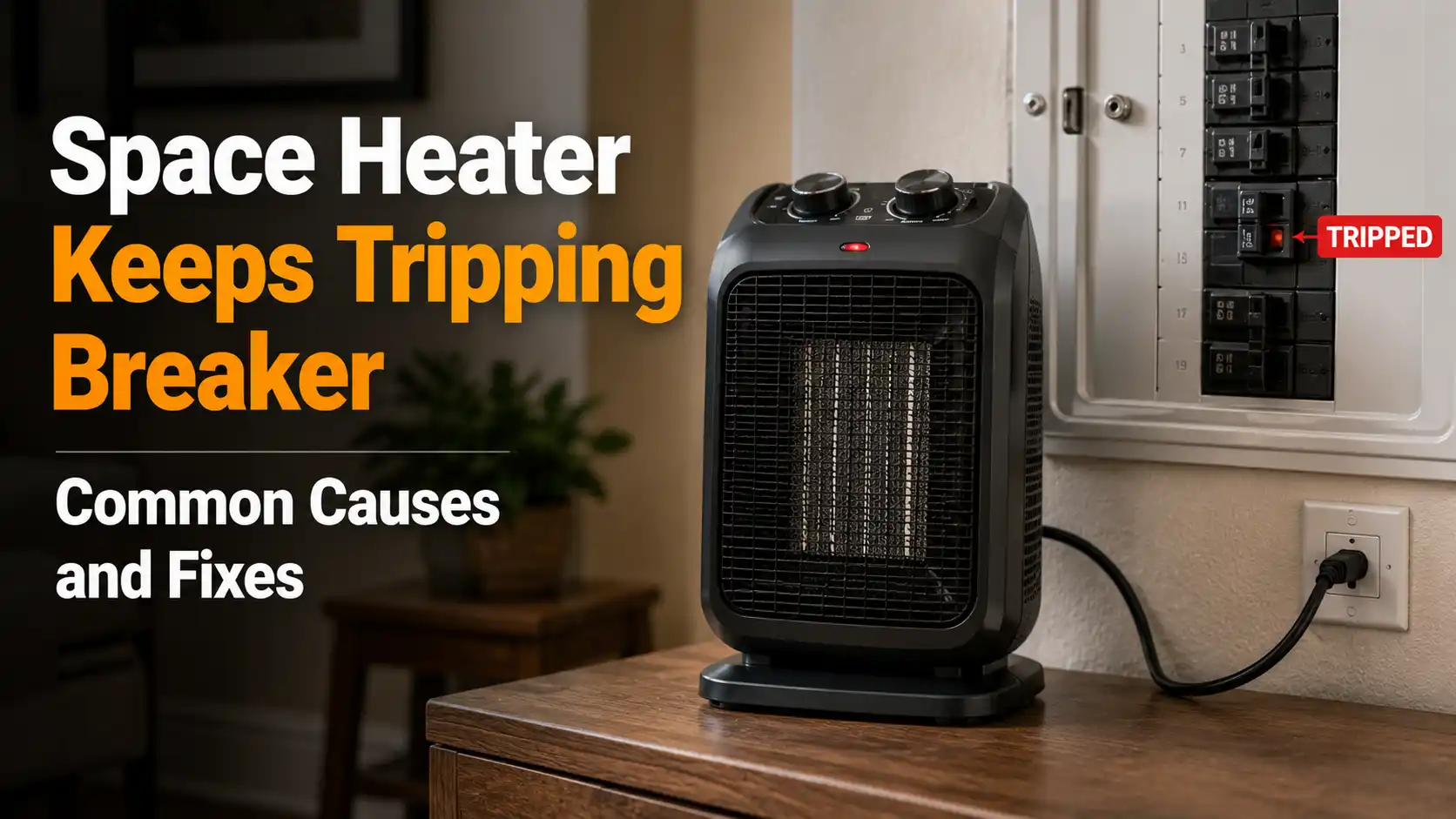

You are settling into your favorite chair on a freezing winter evening. You reach down and click on your portable heater. For a few seconds, everything is perfect. Then, the lights flicker and the room goes pitch black. You hear that dreaded “clunk” from the electrical panel in the hallway. You have just experienced a tripped breaker, and it is likely not the first time it has happened this week.
It is a frustrating cycle. You want to stay warm, but your home’s electrical system seems to have other plans. Many people worry that their heater is broken or that their house is in danger of an electrical fire. If your Space Heater Keeps Tripping Breaker Common Causes and Fixes is a search you have made recently, you are looking for more than just a quick reset. You need to know why this is happening and how to stop it for good.
As an experienced reviewer of home heating products, I have seen this issue in modern apartments and older homes alike. Most of the time, the heater is working exactly as it should. The problem lies in the “math” of your home’s electricity. Let’s look at why your breaker is acting like a bodyguard for your wires and how you can stay warm without the constant power cuts.
TL;DR
- A space heater usually trips the breaker because it pulls too much power for a single circuit to handle alongside other appliances.
- Match the heater to the room size, insulation and the kind of warmth you want instead of choosing by wattage alone.
- Prioritize appropriate safety features, stable placement, direct wall-outlet use and clear manufacturer instructions.
- Check the exact model specifications before purchase because features and retailer listings can change.
Quick Answer: Why Your Breaker Trips
A space heater usually trips the breaker because it pulls too much power for a single circuit to handle alongside other appliances. Most heaters use 1,500 watts, which consumes about 12.5 amps of a standard 15-amp circuit. If you have a lamp, TV, or computer on the same line, the total load exceeds the breaker’s limit, causing it to shut off for safety.

How It Works: The Physics of Power
To understand your problem, you have to look at the numbers. Most homes have circuits rated for 15 or 20 amps. A standard 1,500-watt space heater uses about 12.5 amps. This is a massive amount of energy for one small device.
Think of your circuit like a water pipe. If you try to push too much water through at once, the pipe might burst. The breaker is a safety valve. It “trips” to stop the flow of electricity before the wires in your walls get hot enough to start a fire.
When your Space Heater Keeps Tripping Breaker Common Causes and Fixes becomes a recurring issue, it is usually because the “pipe” is already half-full. If you have a computer pulling 3 amps and a TV pulling 2 amps on the same circuit, adding a 12.5-amp heater pushes the total to 17.5 amps. A 15-amp breaker will trip every single time.
1. Common Causes: Why the Power Cuts Out
There are three main reasons why your heater and your breaker are clashing. Identifying the right one is the first step to a fix.
Overloaded Circuits
This is the most frequent cause. Many rooms share a single circuit. Your bedroom outlets might be connected to the same breaker as the hallway lights and the home office next door. If you run a heater while someone is using a hair dryer or a vacuum in the next room, the total power draw will be too high.
Loose or Damaged Outlets
Electricity creates heat. Over time, the metal contacts inside your wall outlet can expand and contract. This makes them loose. A loose connection creates “resistance,” which generates even more heat. If your outlet feels hot or looks discolored, the breaker might be tripping because the outlet itself is failing, not just because of the wattage.+2
Faulty Internal Components
In some cases, the heater is the problem. If a wire inside the unit is frayed or if the heating element is touching the metal housing, it creates a “short circuit.” This causes a sudden, massive spike in electricity. The breaker trips instantly to prevent an explosion or a fire.
2. Step-by-Step Guidance: Finding a Solution
You do not need to be an electrician to solve most of these problems. Follow this checklist to get your heat back on safely.
Step 1: Map Your Circuit
Go to your electrical panel and look at the labels. If the labels are messy, have someone stand in the room while you flip breakers one by one. This helps you understand exactly which outlets are on the same line. You might be surprised to find that your “bedroom” heater is actually competing with the refrigerator in the kitchen.
Step 2: Clear the Line
Once you know which outlets share a breaker, unplug everything else on that circuit. Turn off the big TV, unplug the printer, and move the lamp to a different wall if possible. A space heater works best when it is the only “heavy hitter” on a circuit.
Step 3: Inspect the Plug and Outlet
Unplug the heater and look at the prongs. They should be shiny and straight. Look at the wall outlet. If you see any black marks or if the plug feels “loose” when you put it in, do not use that outlet. A loose plug is a major fire risk.

Step 4: Use the “Low” Setting
Most heaters have a “High” setting (1,500 watts) and a “Low” setting (750 or 900 watts). If your Space Heater Keeps Tripping Breaker Common Causes and Fixes search led you here, try running the heater on Low. This uses about half the amperage, making it much more likely to work on a shared circuit. If you are comparing options, see our guide to the best space heater for bathroom.

3. Safety Considerations: The Dangers of Forcing It
It is tempting to just keep resetting the breaker, but that is dangerous. Breakers are designed to trip. If you keep flipping it back on without fixing the load, you are forcing the wires in your wall to stay hot.
Never use an extension cord with a space heater. Most extension cords are not thick enough to handle 12.5 amps for long periods. They will get hot, melt, and potentially start a fire long before the breaker even knows there is a problem. Always plug your heater directly into a wall outlet.
Also, avoid using “cheater” plugs or power strips. Power strips have their own internal breakers that are often weaker than your wall breaker. They are not designed for high-heat appliances and can melt internally, creating a hidden fire hazard in your living room.
5. Comparison Insights: 15-Amp vs. 20-Amp Circuits
Most older homes use 15-amp breakers for bedrooms. This is just barely enough for a space heater. Modern homes often use 20-amp breakers for kitchens and living areas.
If you have a choice, always plug your heater into a 20-amp circuit. You can usually tell the difference by looking at the outlet. A 20-amp outlet has a small horizontal “T” slot on one of the vertical holes. These circuits have thicker wiring and can handle the load of a heater much more comfortably.
6. Buying Factors: What to Look For
If you are tired of your current unit causing problems, look for these features in your next purchase.
- Adjustable Wattage: Look for heaters that offer 600, 900, and 1,500 watt options. This gives you the flexibility to use a lower setting on sensitive circuits.
- Digital Thermostats: These units cycle on and off more smoothly. This prevents the sudden “surge” of power that can sometimes trip a weak breaker.
- Internal Fuses: High-quality heaters have their own internal safety fuse. If the heater has a short circuit, its own fuse will blow before it even affects your home’s breaker panel.

Conclusion
Dealing with a Space Heater Keeps Tripping Breaker Common Causes and Fixes situation is a normal part of winter for many people. It does not mean your house is falling apart, but it does mean you need to change your habits. By understanding your home’s “power budget,” you can stay warm without the lights going out.
Remember that a space heater is a high-power tool. It needs its own space and its own electricity. By clearing the circuit and using the right settings, you can enjoy a cozy home with total peace of mind. Trust the safety features of your home and always prioritize a safe connection over a quick warm-up.
If you are looking for a more efficient heater that is easier on your breakers, look for models with “Low Wattage” modes. Check out our latest reviews to find the best heaters for 2026. Stay warm, stay smart, and keep your home’s power flowing smoothly this winter.

Frequently Asked Questions
Can a space heater damage my electrical panel?
It shouldn’t damage the panel itself, but constant tripping can wear out the specific breaker. If a breaker is forced to trip dozens of times, the internal spring can weaken, making it trip even more easily in the future.
Is it okay to use a space heater with a power strip?
No. Power strips are not designed for the high current of a space heater. They can overheat and melt, often without tripping your home’s main breaker. Always plug a heater directly into the wall outlet.
Why does the breaker trip only after 10 minutes?
Breakers work on heat. It takes a few minutes for the wires to warm up under a heavy load. If you are slightly over the limit, it might take 10 or 20 minutes for the breaker to reach the temperature where it finally “snaps” to protect you.
Does the age of my house matter?
Yes. Older homes often have 15-amp circuits and older wiring that may have loose connections. Newer homes are built with 20-amp circuits in many areas, which are much better at handling modern appliances like space heaters.
What should I do if my outlet is sparking?
Unplug the heater immediately and do not use that outlet again. Sparking is a sign of a “short circuit” or a very loose connection. You need a licensed electrician to replace the outlet and check the wires for damage.
Can a "Smart" heater save my breaker?
Not really. All heaters use roughly the same amount of power to create heat. However, a smart heater with a good thermostat will cycle on and off more efficiently, which might prevent a long-term heat buildup in a sensitive breaker.
Why does my heater trip the GFCI outlet in the bathroom?
GFCI outlets are extremely sensitive to “leaks” in electricity. If your bathroom heater has even a tiny amount of moisture inside or a small internal fault, the GFCI will trip instantly to prevent you from getting a shock.+1
