

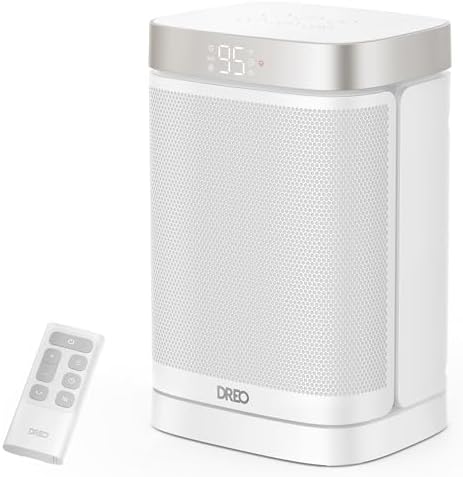
Dreo Atom One vs Ceramic Heater 316: both are compact 1500W PTC ceramic heaters with digital thermostats, ECO mode and remote control, but they solve slightly different problems. Atom One adds 70° oscillation for broader heat distribution, while the Ceramic Heater 316 focuses on stronger straight-ahead airflow in a simpler fixed-angle body.
Dreo currently lists both with a 41–95°F thermostat range and similar compact footprints. The 316 is the better value for focused heat; Atom One is easier to recommend when two people share a room or you want warmth spread across a wider area.
Affiliate disclosure: This post contains affiliate links. We may earn a commission if you buy through them. As an Amazon Associate we earn from qualifying purchases.

Quick Answer
Buy Atom One if oscillation is the feature you will notice every day. Buy Ceramic Heater 316 if you want a lower-cost compact Dreo heater and mostly aim it at one desk, chair or side of the room. Neither changes the basic electrical reality of a 1500W resistance heater: energy use depends mainly on wattage and how long the heater runs.
Dreo Atom One vs Heater 316 Comparison
| Best for | Atom One: wider personal/small-room coverage; 316: focused heat |
| Max heat | Both up to 1500W |
| Thermostat | Both 41–95°F |
| Oscillation | Atom One: 70°; 316: no oscillation |
| Modes | Both include heat, ECO and fan-only modes |
| Timer | Atom One: 1–12 hours; 316: 1–12 hours |
| Noise | Dreo lists both around 37 dB |
| Controls | Touch controls plus remote on both |
Where Atom One Is Better
Atom One’s biggest advantage is simple: it oscillates. If you sit at different positions through the day, share a home office, or want the heater to sweep warmth across a small bedroom, that 70° movement is more useful than a small paper-spec difference. The washable filter is another practical ownership feature because dust buildup can reduce airflow over time.
Read our full Dreo Atom One review if you want the model-specific strengths and drawbacks.
Where Ceramic Heater 316 Is Better
The Ceramic Heater 316 is easier to justify when you mainly need focused heat beside a desk or bed. Dreo’s 2026 lineup comparison shows a faster listed airflow figure for the 316 than Atom One, but the 316 does not sweep that airflow around the room. In practice, this makes it feel more direct when aimed at one location.
Dreo renamed the earlier “Space Heater Atom 316” to “Ceramic Heater 316” in 2026 without changing product functionality. Our Ceramic Heater 316 review explains that naming change in more detail.
Safety and Everyday Use
- Both use PTC ceramic heating and include tip-over and overheat protection.
- Both offer thermostat control, which is more useful than running continuously on high.
- Neither should be used through an extension cord or power strip.
- Keep at least the clearance required by the manual from bedding, curtains and furniture.
Which One Should You Buy?
For most people, Atom One is the more flexible heater because oscillation improves how comfortably one compact unit serves a small room. The 316 wins on simplicity and value when the heater stays pointed at a single zone. If neither is large enough for your use case, see our best Dreo space heaters comparison for larger whole-room models.
Frequently Asked Questions
Is Atom One more powerful than Heater 316?
Both are 1500W maximum-output portable heaters, so Atom One is not meaningfully “more powerful” by wattage.
Does Heater 316 oscillate?
No. Atom One does; the 316 is fixed-angle.
Do both have ECO mode?
Yes. Dreo lists ECO temperature-control modes on both.
Which is better for a desk?
The 316 is excellent for focused desk-side heat. Atom One is better if you want the airflow to move between positions.
Which is quieter?
Dreo currently lists both around 37 dB, so noise should not be the main deciding factor.
Conclusion
Atom One is the safer all-round recommendation because 70° oscillation makes a compact heater more versatile. The Ceramic Heater 316 is the better buy when focused heat and lower cost matter more than room-wide sweep. Dreo’s current heater lineup is useful for checking present model names and availability.


