


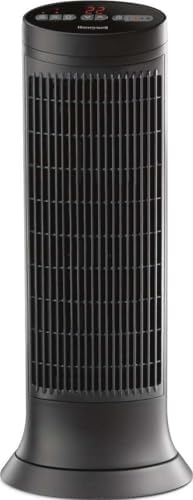
Honeywell HCE317B vs HCE322V: these are very similar 22-inch ceramic tower heaters with oscillation, programmable temperature control and strong safety packages. The HCE317B uses a slim DC-motor design with 1500W high and 750W low heat. The HCE322V uses a dual-motor system and labels its two modes Max Heat and Energy Saver.
Because the housings and use cases are close, the choice comes down to controls and airflow design rather than a dramatic difference in heating power. HCE317B is the easier recommendation if you want a slim, lightweight tower; HCE322V is attractive if you prefer its dual-motor airflow and permanent dust filter.
Affiliate disclosure: This post contains affiliate links. We may earn a commission if you buy through them. As an Amazon Associate we earn from qualifying purchases.

Quick Verdict
Choose HCE317B for a very slim design, clear 1500W/750W heat levels and simple digital controls. Choose HCE322V if you value its dual-motor airflow system and permanent filter. Both include oscillation, timer functions and 360° tip-over protection.
Honeywell HCE317B vs HCE322V Comparison
| Max heat | HCE317B: 1500W; HCE322V: whole-room ceramic max-heat mode |
| Low/efficient mode | HCE317B: 750W; HCE322V: Energy Saver mode |
| Height | Both about 21.6 inches |
| Oscillation | Both: wide-range oscillation |
| Thermostat | Both programmable |
| Timer | Both support timed operation; HCE317B lists 1/2/4/8 hours |
| Tip-over protection | Both: 360° tip-over switch |
| Warranty | Both: 3-year limited warranty |
Why HCE317B Is Easier to Recommend
Honeywell explicitly lists 1500W high and 750W low settings for the HCE317B, which makes the operating choices easy to understand. Its DC motor is also part of the slim design and Honeywell says it helps extend motor life compared with a conventional AC-motor design.
See our Honeywell HCE317B review for the full model breakdown.

Where HCE322V Has an Edge
The HCE322V’s dual-motor system is designed to move warm air effectively through a narrow tower. Honeywell also lists a permanent filter intended to reduce dust and particles entering the heater. That does not turn it into an air purifier, but it can help keep the heater’s airflow path cleaner over time.
Our HCE322V review covers its controls and safety features in more detail.
Safety: Very Similar
Honeywell gives both models a strong safety stack that includes 360° tip-over protection, overheat protection and cool-touch housing. That is a meaningful advantage over older tower heaters that lack tip-over sensing. Still, use either model on a stable floor with proper clearance and a direct wall connection.
Who Should Buy Which?
- Choose HCE317B for a slim tower with clearly stated 1500W and 750W settings.
- Choose HCE322V if the permanent filter and dual-motor design matter more to you.
- If one is substantially cheaper, buy the less expensive model; their overall use cases overlap heavily.
- For more Honeywell options, see our best Honeywell space heaters guide.
Both models are conventional fan-forced ceramic towers, so neither is silent. If fan noise is a major concern for sleep or recording, compare a fanless oil-filled or micathermic heater rather than expecting a small difference between these two Honeywell towers to solve it.
If you are choosing purely on value, compare current prices after shipping and warranty. Because the two heaters are so close in purpose, a meaningful price difference is more important than small differences in motor layout or control labels.
Frequently Asked Questions
Are both Honeywell heaters 22-inch towers?
They are both roughly 21.6 inches tall and use a slim tower format.
Do both oscillate?
Yes. Honeywell lists wide-range oscillation on both.
Which has a 750W low mode?
HCE317B explicitly lists 750W low heat.
Which has a permanent filter?
Honeywell lists a permanent filter on HCE322V.
Which is safer?
They are very close: both include tip-over and overheat protection plus cool-touch housing.
Conclusion
There is no huge winner because HCE317B and HCE322V target the same room-heating job. HCE317B wins on straightforward heat-level labeling and slim simplicity; HCE322V wins if you value its dual-motor airflow and permanent filter. Check Honeywell’s current HCE317B and HCE322V pages before buying.
Airflow and Maintenance Differences
HCE317B’s slim tower and DC motor are designed around a narrow footprint and conventional oscillation. HCE322V’s dual-motor system and permanent filter make airflow maintenance a larger part of its design. The filter should be kept clean according to Honeywell’s instructions so lint and dust do not restrict the heater’s intake.
Neither permanent filter should be mistaken for room air purification. Its purpose is to help protect the heater’s airflow path, not to replace a HEPA purifier. That distinction matters if allergies or airborne particles are part of the buying decision.
Which Model Is Better for Daily Use?
Choose HCE317B when you want clearly defined 1500W and 750W modes, a slim body and simple timer control. Choose HCE322V when its dual-motor airflow and washable/permanent filter are more valuable. If current prices differ substantially, the cheaper model is usually the better value because their core heating jobs overlap.
For either model, use the programmable thermostat to avoid unnecessary full-power runtime. At 1500W, one continuous hour uses about 1.5 kWh; at HCE317B’s 750W low setting, the instantaneous draw is about half that.


