
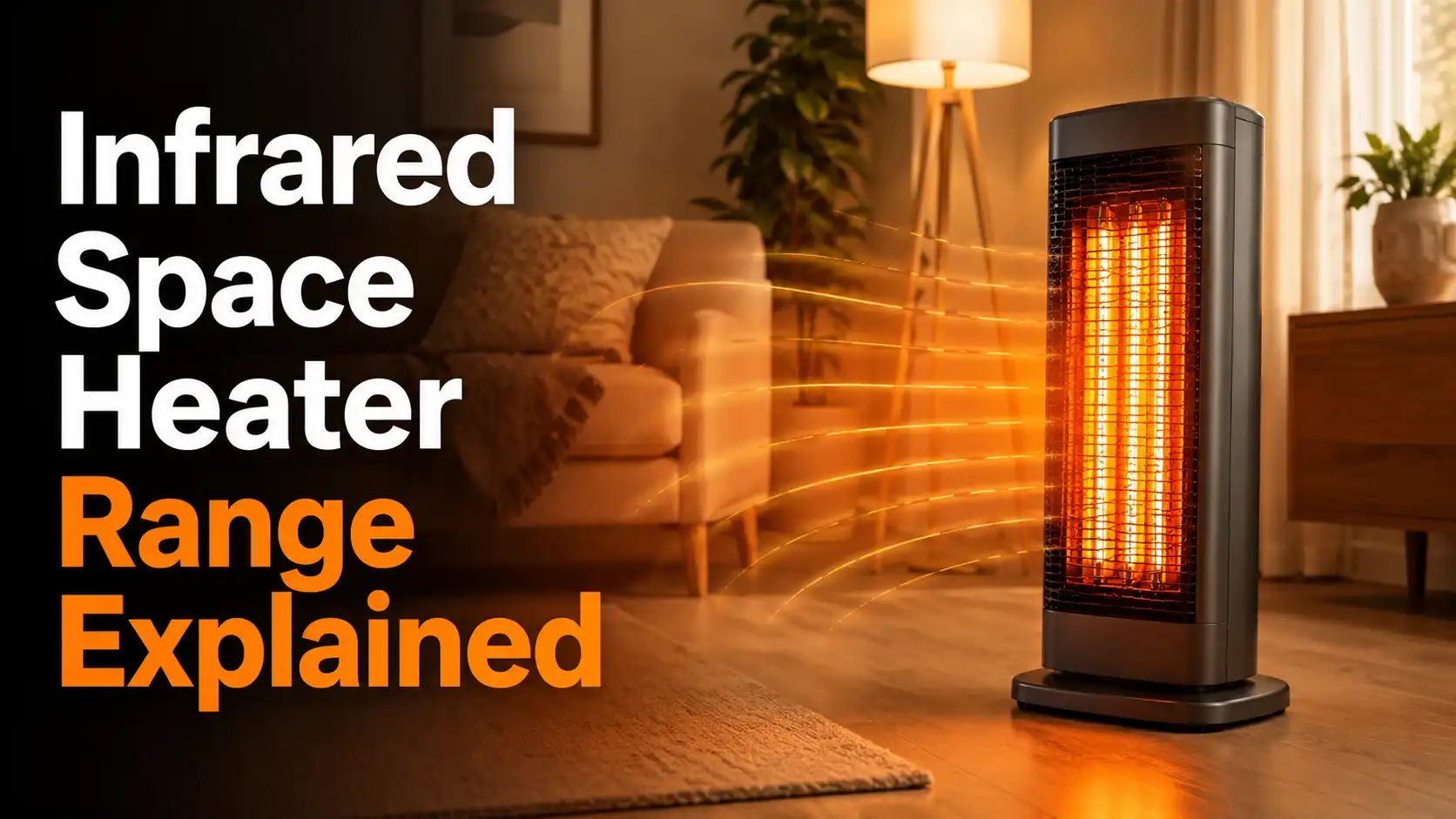


You are sitting in your favorite armchair on a freezing Tuesday evening. You have a small heater running in the corner, but the air feels thin and dry. You feel a draft every time someone walks by. You have heard about infrared technology and how it feels like standing in the sun. You wonder if it can actually reach across your large living room or if it is just another overhyped gadget. For the related safety issue, our What Is a Halogen Space Heater and Is It Safe covers the specific risks and safer checks.
Many people buy these units expecting them to work like a traditional furnace. They get frustrated when the far corner of the room stays icy. Understanding the Infrared Space Heater Range What It Can and Cannot Do is the secret to staying warm without wasting money on your electric bill. It is about knowing where to sit and how the “light” of the heater moves through your home.
As an experienced reviewer of space heaters, I have tested these units in drafty garages and insulated bedrooms. They are unique tools with a very specific set of skills. Let’s look at the science of radiant warmth so you can decide if an infrared unit is the right fit for your specific floor plan.
Paid link. As an Amazon Associate, we earn from qualifying purchases at no extra cost to you.
TL;DR
- An infrared space heater has an effective direct range of about 10 to 15 feet for immediate warmth. It works by heating objects and people directly rather than the air.
- Match the heater to the room size, insulation and the kind of warmth you want instead of choosing by wattage alone.
- Prioritize appropriate safety features, stable placement, direct wall-outlet use and clear manufacturer instructions.
- Check the exact model specifications before purchase because features and retailer listings can change.
Quick Answer: Infrared Heater Performance
An infrared space heater has an effective direct range of about 10 to 15 feet for immediate warmth. It works by heating objects and people directly rather than the air. While it is excellent for instant comfort in its “line of sight,” it cannot efficiently heat large rooms with many obstacles or provide consistent warmth in areas blocked by furniture.


How It Works: The Science of Radiant Light
To understand the Infrared Space Heater Range What It Can and Cannot Do, you have to look at the physics of heat. Most heaters use convection. They warm the air, and that air has to travel to you. Infrared is different. It uses electromagnetic waves to send energy through the air without warming the air itself.
Think of it like a flashlight in a dark room. The light travels in a straight line. If you are in the beam, you are illuminated. In the world of heating, if you are in the “beam” of the infrared waves, you feel warm instantly. The energy only turns into heat when it hits a solid object like your sweater, your skin, or your sofa.
Because it doesn’t rely on moving air, it is incredibly efficient. No energy is wasted heating the high ceilings or the empty space in the middle of the room. However, this also means that if you step behind a coffee table or a wall, the heat disappears immediately. This is the fundamental trade-off of the technology.
2. The Limitations: What It Cannot Do
Despite the fancy marketing on the box, there are things an infrared unit simply cannot achieve. You need to know these limits to avoid “buyer’s remorse.”
Heating Multiple Rooms
An infrared heater cannot heat around corners. If you put one in the hallway, it will not warm the bedroom. The waves must have a clear path to the target. It is strictly a “single-zone” tool. If your room has an L-shape or many partitions, you will find several cold spots.
Maintaining Ambient Air Temperature
If you want the actual air in the room to feel “toasty” like a sauna, infrared is the wrong choice. The air stays relatively cool while the objects stay warm. This can feel strange to some people. You might feel warm on your front side while your back feels the cold room air.
Warming Objects Behind Barriers
Infrared waves cannot pass through solid objects. If you have a large sofa between you and the heater, the sofa will get very warm, but you will stay cold. This makes placement much more difficult than a standard fan heater that circulates air everywhere.
3. Comparison Insights: Infrared vs. Ceramic
When looking at the Infrared Space Heater Range What It Can and Cannot Do, it helps to compare it to the most common alternative.
Ceramic Fan Heaters: These are better for “filling” a room with warmth. They are great for small bedrooms where you want every corner to be the same temperature. They are louder and dry out the air, but they aren’t limited by “line of sight.”
Infrared Heaters: These are better for “personal” warmth in large or poorly insulated rooms. They are usually silent and much better for your skin and sinuses. They are the best choice for sitting on a sofa or working at a desk for long periods.
4. Cost Breakdown: Is It Efficient?
Most infrared heaters use 1,500 watts on their high setting. This is the same as a standard hair dryer or a ceramic heater. On your electric bill, an hour of use costs exactly the same as any other electric heater.
However, the “efficiency” comes from how you use that power. Since you feel warm instantly, you might be able to turn the heater off sooner. You also don’t have to heat the entire 500 square feet of a room just to be comfortable in your chair. This targeted heating can save you 10% to 15% on your monthly bill compared to a whole-house furnace.
5. Safety Considerations
Safety is the most important part of any heater review. Infrared units have specific rules you must follow.
The Front Grille
The heating elements inside (often quartz tubes) get extremely hot. While the housing might stay cool, the front grille can cause a burn if a child or pet touches it. Always look for units with a “cool-touch” exterior and protective mesh.
Distance from Fabric
Because the radiant waves are intense, you must keep curtains, bedding, and furniture at least three feet away. If a blanket is too close to a high-powered infrared beam, it can eventually scorch or catch fire. Always maintain a clear “path” for the heat waves.
7. Buying Factors: What to Look For
Before you spend $100 or more, check these details on the box.
- Tube Type: Quartz tubes are common and provide intense heat. Carbon fiber tubes are often more durable and provide a “softer” heat that some people find more comfortable.
- Cabinet Style: “Cabinet” heaters often have wheels and a wood-look finish. These are great for living rooms. Small “tower” models are better for offices.
- Digital Thermostats: Look for a unit that lets you set a specific temperature. This prevents the heater from running on “High” for five hours and wasting energy.
Practical Tips
- The “Hand Test”: Stand where you usually sit and have someone turn the heater on. If you don’t feel the warmth within 10 seconds, the heater is either too far away or pointed in the wrong direction.
- Use for “Zone Heating”: Turn your central furnace down to 62 degrees and use the infrared heater to stay warm in the room you are actually using.
- Pre-Heat Your Furniture: Turn the heater on 10 minutes before you sit down. It will warm up the sofa cushions so you aren’t sitting on a cold surface.
- Unplug When Not in Use: Like all high-wattage appliances, it is safer to pull the plug when you leave the house or go to bed.
Common Mistakes to Avoid
A very common mistake is putting an infrared heater under a desk. Because the waves are so intense at close range, it can actually make your legs uncomfortably hot while the rest of your body stays cold. These units need a bit of distance to work their best.
Another mistake is buying an infrared heater for a nursery or a toddler’s playroom. Because these units rely on “line of sight,” an active child who is running around won’t stay in the heat beam long enough to be comfortable. A convection heater or an oil-filled radiator is much better for kids who don’t sit still.
Frequently Asked Questions
Can an infrared heater heat a whole room?
Yes, but it does so indirectly. It heats the furniture and walls first. Those objects then slowly give off heat to the air. It takes much longer to warm the air than a convection heater, but the “feel” is often more comfortable once it gets there.
Is infrared heat safer for pets?
Generally, yes. Since they are usually silent and don’t blow air, they don’t scare cats or dogs. However, you must ensure your pet doesn’t lay too close to the front grille, as their fur can soak up a lot of heat very quickly.
Why does my infrared heater smell like it's burning?
If the unit is new, it is likely just the factory coating burning off. If it is old, it is probably dust on the quartz tubes. Unplug the unit and clean the vents with compressed air to stop the smell.
Do infrared heaters use a lot of electricity?
They use the same 1,500 watts as most other space heaters. However, they can be cheaper to run because you don’t have to leave them on as long to “feel” warm. Targeted heating is always cheaper than whole-room heating.
Can I leave an infrared heater on all night?
No portable space heater should be treated as safe to leave running while you sleep or when it is unattended. CPSC recommends turning portable heaters off when sleeping, plugging electric heaters directly into a wall outlet, and keeping them at least three feet from bedding, curtains, furniture, and other combustible materials.
Are infrared heaters good for basements?
They are excellent for basements. Basements often have concrete walls that “steal” heat from the air. Infrared ignores the air and heats you directly, making it much more effective in cold, underground spaces.
Does infrared light from heaters hurt your eyes?
Standard home infrared heaters use “Far Infrared” waves which are safe. However, you should not stare directly into the glowing heating elements for long periods, as the intense light can cause eye strain.


