
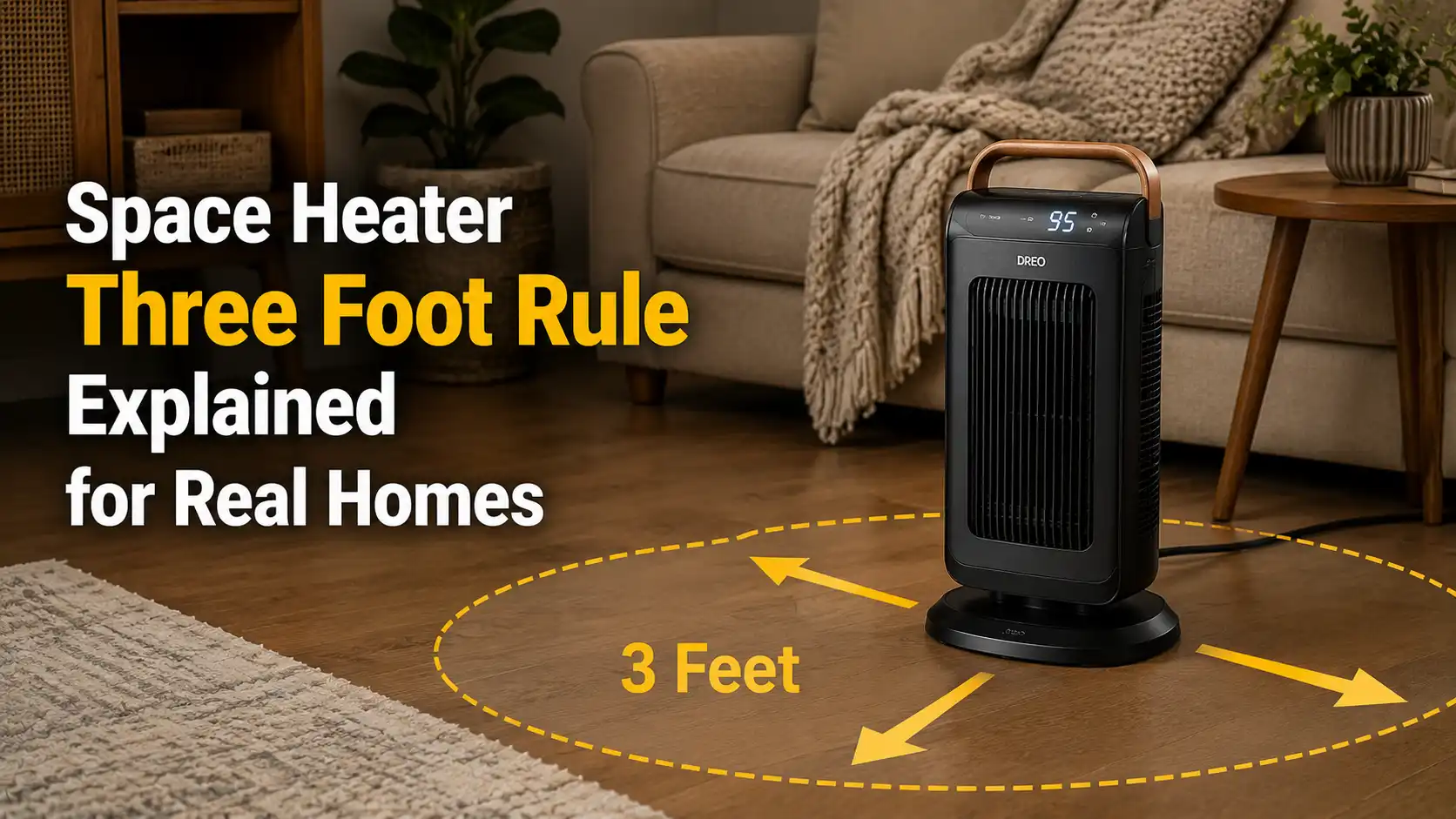


Keep a portable space heater at least 3 feet, or about 0.9 meters, from bedding, curtains, furniture, clothing, paper, rugs, and other materials that can burn. CPSC uses this three-foot clearance as a core portable-heater fire-safety rule. For the related safety issue, our Space Heater Safety for Curtains Bedding and Rugs covers the specific risks and safer checks. For closely related guidance, see our How Far Should a Space Heater Be from Furniture.
The distance is not only about the front grille. CPSC safety material advises keeping all sides of a portable heater away from combustible items. Your heater manual can require additional clearance, so use the manufacturer’s instructions when they are more restrictive.
Paid link. As an Amazon Associate, we earn from qualifying purchases at no extra cost to you.
TL;DR
- Keep all sides of a portable heater at least 3 feet from items that can burn.
- Place the heater on a stable, level surface where it will not be knocked over.
- Plug an electric portable heater directly into a wall outlet, not a power strip or extension cord.
- Turn the heater off when you leave the room or go to sleep.
What Is the Space Heater Three-Foot Rule?
The rule means maintaining at least 36 inches of clear space between the heater and combustible materials. CPSC specifically names beds, sofas, curtains, clothing, papers, and similar items. See the CPSC portable electric heater safety guidance.
| Keep at least 3 feet away from | Why it matters |
|---|---|
| Bedding and blankets | Fabric can fall or shift toward the heater |
| Curtains and drapes | Air movement can bring fabric into the heat path |
| Sofas and upholstered chairs | Combustible fabric and foam can absorb heat |
| Paper, books, clothing, boxes | Easy-to-ignite clutter should stay outside the safety zone |
| Rugs and carpet around the heater | Follow the heater manual; CPSC recommends a stable, level surface and older CPSC guidance specifies hard, nonflammable surfaces |
Does the Three-Foot Rule Apply to All Sides?
CPSC’s portable-heater safety material says to keep all sides of the heater at least three feet from items that can catch fire. Do not assume the back or side is safe to crowd just because the strongest heat comes from the front.

Some heater manuals specify particular front, rear, top, and side clearances. Always follow the exact manual, especially when it requires more space than the general three-foot rule. For related safety guidance, read our guide on space heater safety for curtains bedding and rugs.
How to Use the Rule in a Small Bedroom or Office
Do not squeeze a portable heater between a bed and nightstand, under a desk full of paper, behind a chair, or beside hanging curtains just because the room is small. If you cannot create the required clearance from combustible materials, that location is not suitable for that portable heater. For more detail on this topic, see our guide to how far should a space heater be from furniture.
Choose a clear location that does not create a trip hazard. Before turning the heater on, check the full three-foot area for blankets, clothes, bags, paper, pet beds, and anything that could shift into the heater while it is running.
Safe Surface and Outlet Placement
Clearance is only one part of safe placement. CPSC recommends a stable, level surface where the heater is unlikely to be knocked over. For electric portable heaters, plug directly into a wall outlet and never into an extension cord or power strip. For the related safety issue, our Where to Place a Space Heater Safely (Placement Guide) covers the specific risks and safer checks.
- Do not run the power cord under rugs or carpeting.
- Do not place the heater where people regularly walk.
- Do not use a loose, damaged, hot, or discolored outlet.
- Keep the heater away from water unless the exact product is designed and rated for that environment.
Children and Pets Need Extra Separation
The three-foot zone should also stay clear of children and pets. A tip-over switch can reduce risk, but it does not make a hot heater safe to touch or play around. Keep toys, pet bedding, and play areas out of the heater’s clearance zone.

Common Three-Foot Rule Mistakes
- Using Low mode as an excuse to move the heater closer: lower wattage does not cancel the clearance requirement.
- Only measuring the front: maintain clearance around all sides as directed by CPSC and the product manual.
- Putting the heater beside curtains: curtains can move into the heater’s safety zone.
- Drying clothes on or near the heater: clothing belongs outside the clearance area.
- Leaving the heater on while sleeping: CPSC says to turn portable heaters off when sleeping.
Space Heater Placement Checklist
- Measure at least 3 feet from combustible materials on all sides.
- Read the heater manual for model-specific clearance.
- Use a stable, level placement.
- Keep the cord visible and out from under rugs.
- Plug directly into a suitable wall outlet.
- Keep children and pets away.
- Turn the heater off before sleeping or leaving the area.

Frequently Asked Questions
How far should a space heater be from curtains?
At least three feet, and farther if the heater manual requires it. Make sure curtains cannot blow or fall into the clearance zone.
Does the three-foot rule apply behind a space heater?
CPSC safety material advises keeping all sides at least three feet from items that can catch fire. Also follow any model-specific rear clearance in the manual.
Can I use a space heater on carpet?
Follow the heater manual. CPSC has long recommended stable, level placement and has published guidance favoring hard, nonflammable surfaces rather than rugs or carpet.
Does infrared heat need three feet of clearance?
Use the same general combustible-clearance rule for a portable infrared heater unless its manual requires more clearance.
Can I move the heater closer on the 750W setting?
No. Lower wattage does not remove the clearance requirement. Keep combustibles outside the safety zone.
Can I leave a space heater on while sleeping?
No. CPSC recommends turning portable heaters off when sleeping.


