
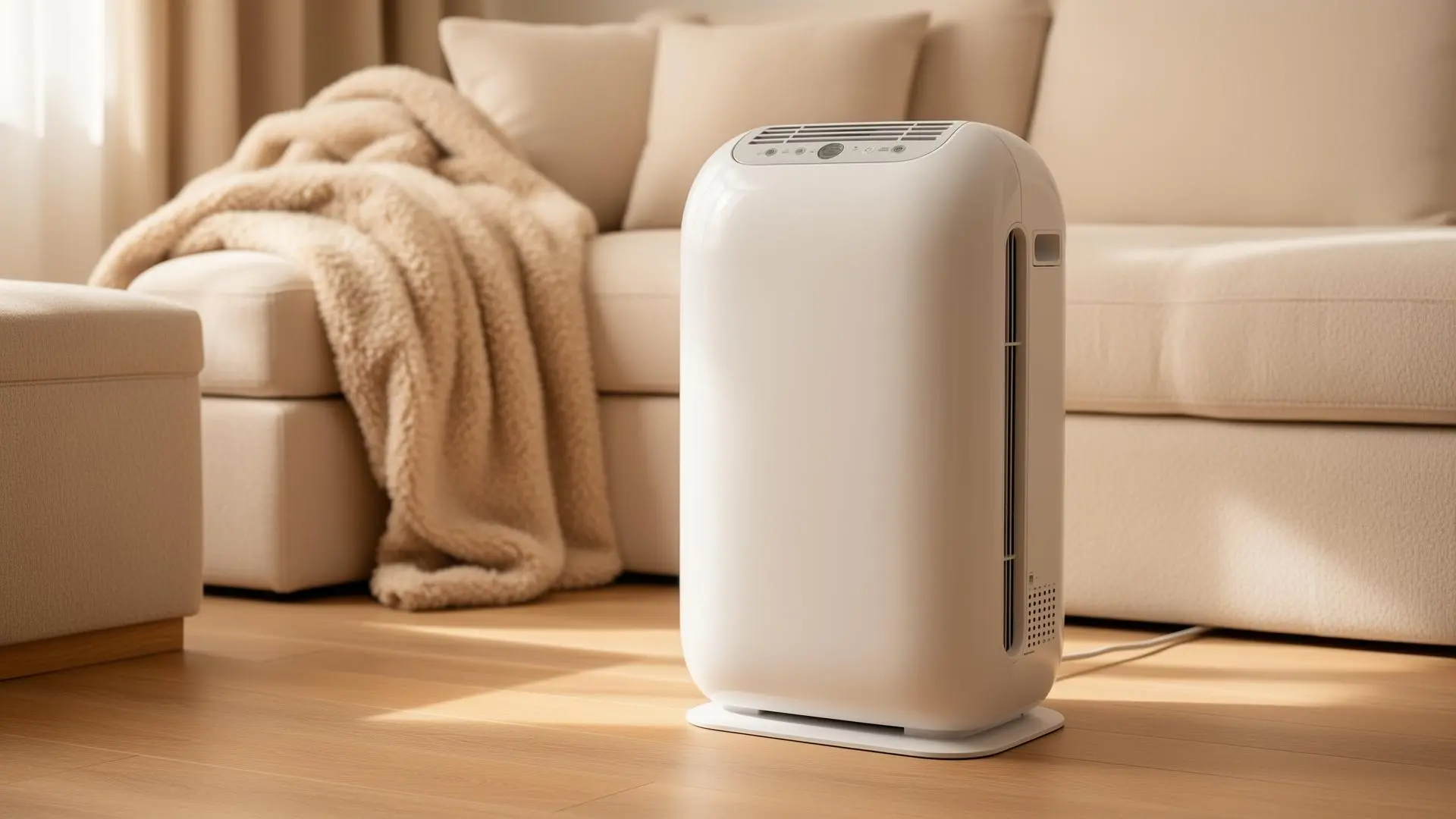


Searching for a battery-powered space heater to get through a winter power outage? You are probably asking two things: “Do power stations support heaters at all?” and “How big of a battery do I need?” A portable power station can technically power some electric heaters, but it has to meet the heater’s continuous wattage requirement, and the battery often runs down much faster than expected.
Short answer: A 1,500-watt space heater needs a power station rated to deliver at least 1,500W continuously. Even a 2,000Wh battery would last only about 1 hour and 8 minutes at that load using the 85% planning assumption below. Running the same heater continuously for eight hours calls for roughly 14.1kWh of nominal battery capacity, before any additional reserve. Most portable power stations are not practical for overnight room heating. More importantly, the U.S. Consumer Product Safety Commission (CPSC) says to turn portable space heaters off while sleeping.
Affiliate disclosure: We may earn a commission from qualifying purchases through linked buying guides, at no extra cost to you.
TL;DR: Can a portable power station run a space heater?
- Check watts first. A station with a 1,000W continuous AC output cannot safely support a heater drawing 1,500W just because it advertises a higher surge rating.
- Check watt-hours second. Battery capacity is a fuel-tank measurement. A 1,000Wh station might power a 500W heater for about 1 hour 42 minutes, assuming a compatible inverter and 85% usable-energy estimate.
- Eight hours of 1,500W heat takes about 14.1kWh of nominal storage at that assumption, making it impractical for many portable setups.
- Do not run a portable space heater while you sleep. Follow CPSC guidance and both device manuals. A heater-capable battery does not make overnight operation safe.
Will a portable power station actually run a space heater?
Sometimes, yes, but only if the heater and power station are compatible. A power station has two separate ratings that answer different questions:
- Continuous AC output (W): How much power the station can supply at once. A 1,500W heater needs at least 1,500W of continuous rated output, with any other connected loads included.
- Battery capacity (Wh): How much stored electrical energy the station has. This determines approximately how long it can power the load.
- Surge or peak output (W): A short-duration limit, not a promise that the station can run a heater at that wattage continuously.
For example, imagine two stations. Station A stores 2,000Wh but has only a 1,000W continuous inverter. Station B stores 1,000Wh and supplies 2,000W continuously. Station A has the larger battery but cannot support a standard 1,500W heater at its rated output. Station B has enough output but would have a short runtime.

Manufacturers make the same distinction: EcoFlow’s power-station sizing guide recommends matching the normal continuous inverter rating to the load, then sizing watt-hours for runtime. If a model claims a special power-lifting or overload mode, do not treat that mode as equivalent to its normal continuous output.
How long will a battery run a space heater? Runtime chart
Use this simple planning formula for a heater running steadily at a known wattage:
Estimated runtime in hours = battery capacity (Wh) × 0.85 ÷ heater wattage (W).
The 0.85 multiplier assumes that 85% of the nominal battery capacity reaches the appliance after conversion and other losses. It is a rough estimate, not a tested efficiency for every power station. EcoFlow uses a comparable planning formula and notes that results vary by load, temperature and other conditions.
| Nominal battery size | 500W heater | 750W heater | 1,500W heater |
|---|---|---|---|
| 500Wh | About 51 min | About 34 min | About 17 min |
| 1,000Wh | About 1 hr 42 min | About 1 hr 8 min | About 34 min |
| 2,000Wh | About 3 hr 24 min | About 2 hr 16 min | About 1 hr 8 min |
| 3,000Wh | About 5 hr 6 min | About 3 hr 24 min | About 1 hr 42 min |
Important: Every time estimate assumes that the power station can supply the heater’s continuous wattage. A 500Wh station with a 300W inverter will not run a 500W heater, even though the table gives an energy-based estimate. Times also assume a full battery, no other devices drawing power, a fairly constant heater load and the 85% planning factor. Actual results may be shorter.
A thermostat that switches the heater off for part of the time can make the battery last longer on the clock, but it also means the heater is delivering heat for fewer minutes. If you need a fixed amount of heat through a cold night, you cannot count on thermostat cycling to create free energy.
How big of a battery do you need for eight hours?
Reverse the formula: Required nominal battery capacity (Wh) = heater wattage (W) × hours ÷ 0.85. For eight hours of continuous heating, the math looks like this:
| Heater power | Energy used in 8 hours | Estimated battery capacity needed |
|---|---|---|
| 500W | 4.0kWh | About 4.7kWh |
| 750W | 6.0kWh | About 7.1kWh |
| 1,500W | 12.0kWh | About 14.1kWh |
Those are mathematical energy requirements, not recommendations to leave a portable heater on overnight. The numbers exclude other devices, reserve capacity and extra losses; they also do not address electrical or fire safety. An eight-hour target that needs 14.1kWh is closer to a large expandable home battery system than the compact “solar generator” many people carry camping.
If your question is “how big of a battery to buy to keep the family warm during storm outages,” start by separating essential backup loads from room heating. A phone, lighting, router or medically necessary powered equipment can have a much lower energy requirement than resistance heating. For a broader plan, see our space heater safety tips for power outages and storms.
A real-world example: A 2,000Wh station with a 1,500W heater
- Read the heater’s label: Suppose its high setting draws 1,500W. If it has a low setting, check the actual stated wattage instead of guessing.
- Check the station’s continuous AC output: It must be able to support at least 1,500W plus anything else running. Its surge number does not replace that requirement.
- Check battery capacity: Suppose it has 2,000Wh of nominal storage.
- Estimate the runtime: (2,000 × 0.85) ÷ 1,500 = 1.13 hours, or about 68 minutes.
- Check permission and safety: Confirm that the specific heater and power-station manuals explicitly allow the proposed connection and load. Do not use an extension cord or power strip to make the setup work.
For context, Jackery lists an estimated 1.1 hours for a 1,500W heater or furnace on its 2,042.8Wh Explorer 2000 Plus. That manufacturer example is close to our energy-based estimate, but it does not prove that every 2,000Wh station can power every space heater or that unattended use is appropriate.
Would a 500W or 750W space heater work better?
A lower-watt heater draws energy more slowly, so the same battery runs longer. With 1,000Wh of nominal storage, our example gives approximately 1 hour 42 minutes at 500W compared with 34 minutes at 1,500W. But lower wattage also means less heat per hour. A 500W heater will not generally warm a large, cold room as quickly as a 1,500W heater.
Look for a model with a genuinely rated 500W or 750W setting, if the power-station manufacturer permits the load. Do not assume a thermostat setting marked “low” changes electrical draw in the way you need. Our low-wattage space heater guide explains the practical options, while how many watts a space heater uses covers reading wattage labels and estimating electricity consumption.
What about “battery-powered” mini heaters or USB heaters?
The phrase battery-powered space heater is often used loosely. You might see three different products described this way:
- A conventional plug-in space heater connected to a portable power station. This is the setup the calculations above describe.
- A small USB-powered warming gadget. Its low power demand may suit personal or localized warming, but it is not equivalent to a 500W to 1,500W room heater.
- A specialized battery-operated personal warmer. Check its actual heat output and intended use; marketing photos do not establish that it can heat a room.
Heating a room requires substantial energy. A gadget that can run for many hours from a tiny internal battery is likely delivering far less heat than a household space heater. Compare actual input watts, heat output and intended coverage before buying.
Is it safe to plug a space heater into a portable power station?
Do not assume it is safe merely because the station has a household-style AC outlet. CPSC’s general guidance for electric space heaters is to plug them directly into a wall outlet, never an extension cord or power strip, keep them at least three feet from things that can burn, and turn them off when sleeping. Read the CPSC guidance before making an emergency heating plan.
Some power-station makers advertise that certain models can technically support heaters. That does not override the heater’s own instructions or CPSC’s fire-safety precautions. If you are considering this setup, check the exact model manuals or ask both manufacturers whether a portable electric space heater is an approved load. If the connection is not clearly allowed, do not improvise.
- Never bypass an overload shutoff, use a “power boosting” claim as permission to exceed the normal output rating, or daisy-chain adapters, power strips and extension cords.
- Keep the heater and station dry, stable and away from bedding, curtains and other combustibles; do not block the station’s cooling vents or place it where heated airflow hits the battery.
- Supervise any approved heater setup while awake. Turn the heater off before going to sleep or leaving the room.
- Check smoke and carbon monoxide alarms, and follow manufacturer rules about charging, discharging and storage temperatures.
- Never use a gasoline, propane or other fuel-burning generator indoors, in a garage, or close to doors or windows. Those devices can produce deadly carbon monoxide.
CPSC recommends operating portable generators outside, at least 20 feet away from the home with exhaust pointed away from buildings. A rechargeable power station does not burn fuel during normal discharge, but its battery and inverter still have their own limits and safety instructions.
What works better for keeping warm during an outage?
If the goal is to stay comfortable while preserving battery power, compare the job each product is meant to do:
| Option | Typical power demand or issue | Best use case |
|---|---|---|
| 1,500W room heater | Very high battery demand; about 1.1 hours from 2,000Wh in our example | Short, awake, supervised room heating only when manuals allow |
| 500W room heater | About one-third the electrical draw of 1,500W, but also less heat output | Small-area heating with a compatible, approved supply |
| Manufacturer-approved heated throw or blanket | Often much lower draw than heating room air; check the item’s actual wattage and use rules | Warming a person rather than the whole room |
| Warm clothing, blankets, draft reduction | No battery draw | First-line comfort measures during an outage |
An electric blanket or heated throw can focus warmth on a person instead of warming all the air in a room. Use only as its manufacturer permits, and never assume every electric blanket is designed for unattended or sleeping use. For a cost-and-use comparison, read space heater vs. electric blanket.
For severe cold, vulnerable household members or an extended power outage, make a backup plan that does not depend on a compact battery running a room heater. Follow local emergency advice about warming centers and safe alternate heat. If you need to know why an ordinary heater should not stay on through the night, see can you leave a space heater on overnight?
Before buying a power station for a heater, check these seven things
- Heater input watts: Check the label or manual for the specific heat setting, not a product photo or generic claim.
- Continuous AC output: Make sure it exceeds the load you intend to run. Check total and per-outlet limits.
- Battery capacity in Wh: Use the runtime formula; do not confuse a 2,000W inverter with a 2,000Wh battery.
- Explicit compatibility: Confirm both manuals permit the exact connection and the heater load.
- Rated AC efficiency and idle draw: Manufacturer runtime tools or tested figures may be more accurate than the 85% rule of thumb.
- Operating limits: Check ventilation, battery temperatures, charging requirements and overload protection.
- Your real purpose: Decide whether you need brief daytime heating, emergency lighting, communication or a genuine home-heating backup system. These require very different battery budgets.
Frequently asked questions
Can a 1,000W power station run a 1,500W space heater?
No, not at its normal rated output. A 1,500W heater exceeds a 1,000W continuous AC inverter rating. Do not use a short-term surge rating or an unverified special mode to justify running a constant overload.
How long will a 1,000Wh power station run a 1,500W heater?
If the station has a compatible inverter rated for at least 1,500W continuous output and the manuals allow the load, the 85% energy estimate is about 34 minutes: 1,000Wh × 0.85 ÷ 1,500W. Many stations with 1,000Wh of battery capacity do not have sufficient continuous output, so check that first.
Can a Jackery, EcoFlow or BLUETTI run a space heater?
Some individual models can supply the necessary continuous wattage. Brand name alone does not establish compatibility. Compare the exact station’s AC rating and watt-hour capacity with the heater label, check both manuals, and follow CPSC space-heater precautions.
What size solar generator do I need to run a 500W heater all night?
Eight hours at a constant 500W would use 4,000Wh of appliance energy. At an illustrative 85% usable-energy factor, that is about 4,706Wh, or 4.7kWh, of nominal battery capacity before any reserve. This is only sizing math: CPSC advises turning portable space heaters off while sleeping.
Will a space heater work better on its low setting with a battery?
It can run longer if low mode truly reduces the heater’s input watts. For example, 500W uses one-third as much electricity per hour as 1,500W, but it supplies correspondingly less heat. Check the specific heater’s rated settings and do not count on its thermostat to guarantee a runtime.
Can I leave a battery-powered space heater on overnight?
No portable space heater should be left running while you sleep. Battery operation does not remove fire, hot-surface or tip-over risks. CPSC tells consumers to turn portable heaters off when sleeping, and you should follow the instructions for both the heater and the power source.
Bottom line: A power station is backup electricity, not an overnight room-heating shortcut
A portable power station can sometimes run a space heater for a short period, but “can it start?” and “how long will it last?” are separate questions. Check continuous watts first, watt-hours second, and compatibility and fire-safety rules throughout. For a constant 1,500W heater, a 2,000Wh battery provides only about an hour in this planning example; an eight-hour target takes battery capacity on an entirely different scale.
If you are preparing for a storm, use your battery budget carefully and make a safe warming plan. A large battery does not make it okay to leave a portable space heater operating while you sleep.
Sources and review date
Reviewed October 31, 2026. Runtime calculations in this article use an illustrative 85% usable-energy factor, consistent with the method described in EcoFlow’s power-station planning guide. Wattage and manufacturer-specific runtime were cross-checked against EcoFlow’s continuous-output advice and Jackery’s Explorer 2000 Plus example. Safety guidance comes from the U.S. Consumer Product Safety Commission. Always consult the current manuals for your exact heater and power station.


