
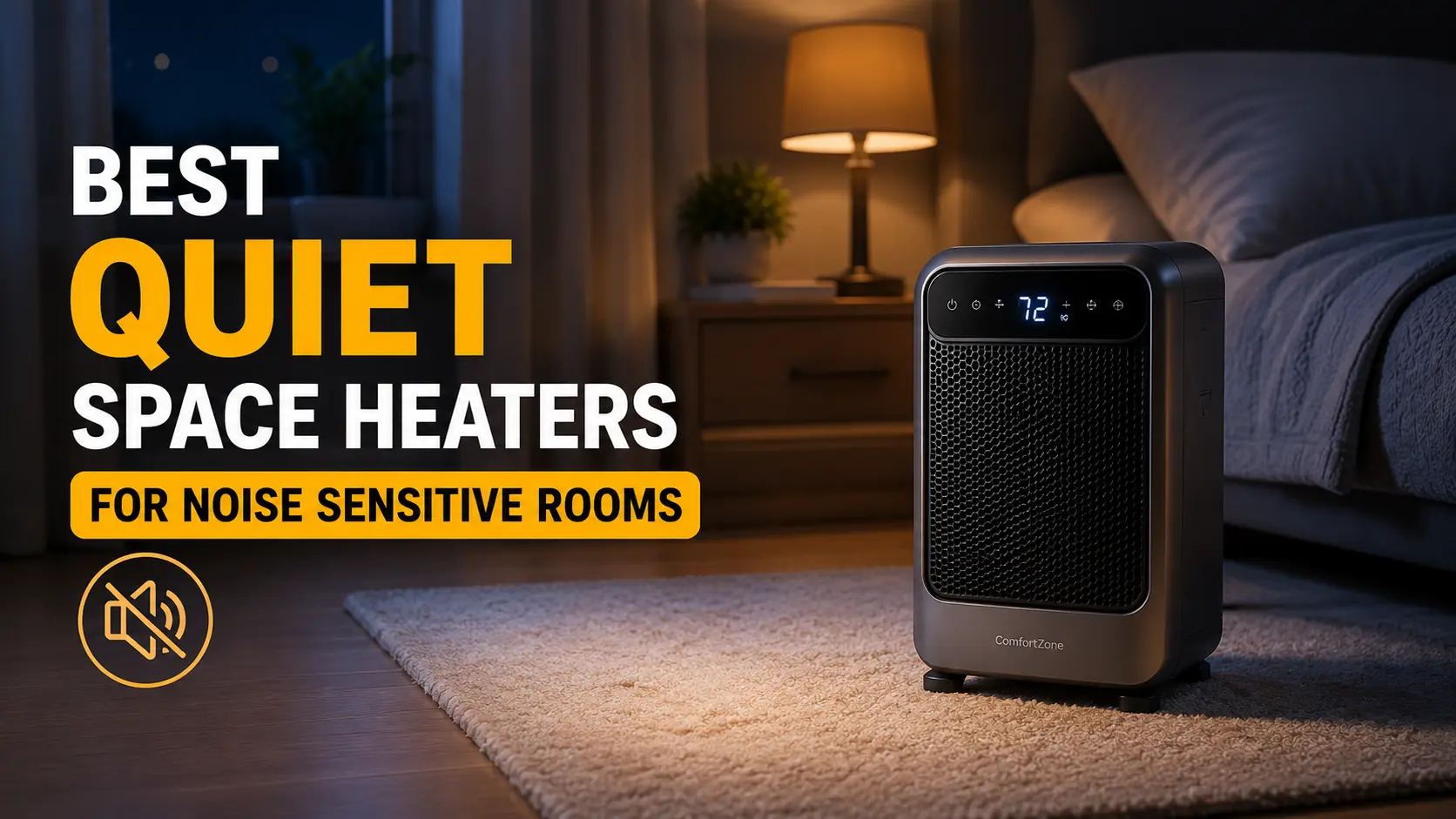


Staying warm in the winter should not mean dealing with a noisy fan or a clicking thermostat. Many people are sensitive to sound and find that regular heaters make it hard to sleep. Some heaters also have bright lights that can ruin the dark in a bedroom. For another model-specific option, see our Vornado VH200 heater review.
If you want a peaceful room, you need to look at the noise level and the type of heat the unit makes. Modern engineering has made it possible to find units that run very quietly while still giving off plenty of warmth. This report explores the best quiet space heaters available today for bedrooms, nurseries, and home offices.
The quietest options usually come in two forms. You can find fanless oil radiators or high tech ceramic towers with smooth fans. Fanless models are silent because they have no moving parts. Ceramic models use fans, but the best ones use special blades to keep the sound low.
Most of these units offer a range of 1500 watts, which is the standard for heating a medium room. Selecting the right one depends on how much noise you can handle and how fast you need the room to get warm.
For a model-specific example within quiet room heaters, see our Comfort Zone CZ499R Ceramic Tower Heater Review for controls, safety features, heating style, and practical fit.
Paid link. As an Amazon Associate, we earn from qualifying purchases at no extra cost to you.

TL;DR
- For the lowest possible noise, fanless oil-filled radiators are usually the quietest choice because they have no fan.
- If you want faster warm-up, choose a modern ceramic heater with a documented low-noise mode, adjustable thermostat, and timer.
- For bedrooms and sound-sensitive rooms, prioritize low operating noise, dimmable controls, automatic temperature regulation, and established safety features.
Quick Picks Summary Table
The table below shows the top quiet heaters based on their noise levels and primary features. These models were chosen because they perform well in quiet environments like offices and bedrooms.
| Product Name | Heating Type | Noise Level (dB) | Key Advantage |
| Dreo Solaris Tower 818 | Ceramic Convection | 25 dB | Whisper quiet operation |
| Vornado MVH Vortex | Vortex Forced Air | Minimal | No bright display lights |
| Lasko CW210 Bladeless | Impeller Technology | Near Silent | Modern bladeless design |
| Pelonis Oil Radiator | Radiant Heat | Silent | Long lasting fanless heat |
| Dr. Infrared DR-968 | Infrared Dual System | 39 dB | Soft heat for large rooms |
| Dreo Solaris Slim H3 | Ceramic Forced Air | 34 dB | Fast heat and very portable |
| Lasko Ellipse Ceramic | Ceramic Forced Air | Low Hum | Compact for desktops |
| Vornado VH2 | Vortex Whole Room | Quiet Hum | Consistent room temperature |
| Honeywell HHF360V | 360 Degree Ceramic | Manageable | Heat in every direction |
| Dyson HP01 | Bladeless Purifier | Adjustable | Clean air and quiet heat |


Short Buying Snapshot
When you buy a quiet heater, you should focus on three main things. These are the noise level, the heating speed, and the safety features. Most people want a heater that stays under 45 decibels. For comparison, 25 decibels is like a whisper in a library. If you need a heater for sleeping, a model around 25 to 35 decibels is perfect. You should also check if the heater has a sleep timer or an ECO mode. These features help save energy and can turn the heater off after you fall asleep.
Safety is the most important part of any space heater. Look for a unit that has a tip over switch and overheat protection. A tip over switch turns the unit off if it gets knocked over. This is great if you have pets or kids. Overheat protection stops the unit if it gets too hot inside. Many quiet heaters also have a cool touch case. This means the outside stays cool even when the heater is running on high.
How to Choose a Quiet Space Heater
Understanding Decibels and Noise Types
When you look for a quiet heater, you will see decibel ratings. A decibel is a unit that measures how loud a sound is. Most quiet heaters are between 25 and 45 decibels. For a very quiet room, you should stay below 35 decibels. If a heater is above 50 decibels, you will definitely notice it.
Comparing Heating Technologies
There are three main ways a space heater makes warmth. Each one has a different noise level.
Features for Light and Sound Sensitive Users
If you are sensitive to noise, you might also be sensitive to light. Many heaters have bright blue or white LED displays. In a dark room, these can be very bright. Look for a heater that lets you turn the screen off. Some models have a “sleep mode” that dims the lights after a few seconds.
Room Size and Power Usage
Most quiet heaters use 1500 watts of power. A general rule is that you need 10 watts for every square foot of space. So, a 1500 watt heater is good for a 150 square foot room. If your room has high ceilings or poor insulation, you might need a more powerful unit or two smaller ones.
Safety and Placement Tips
A quiet heater should always be placed on a flat, hard surface. Placing a heater on a thick carpet can block the air intake and cause it to overheat. It can also make the heater vibrate more, which creates noise. You should keep the heater at least three feet away from curtains, bedding, and furniture.
Frequently Asked Questions
Why does my heater smell like plastic?
This is normal for new heaters. It is called off-gassing. The heat is burning off the oils and dust from the factory. The smell should go away after you run it for a few hours. It is best to do this in a room with a window open the first time you use it.
Can I plug my heater into a power strip?
No. You should never plug a space heater into a power strip or an extension cord. Heaters use a lot of power. They can cause a power strip to overheat and start a fire. Always plug the heater directly into a wall outlet.
How do I stop my heater from clicking?
Clicking is usually caused by the heater parts expanding as they get hot. You cannot always stop it, but making sure the heater is on a level floor can help. If you have a radiator, make sure the mounting brackets are tight. Sometimes, a little space between the heater and the wall can also reduce the noise.
What is the quietest type of heater?
Oil-filled radiators are the quietest because they do not have a fan. They are almost completely silent. If you need a heater with a fan, look for “bladeless” or “impeller” models, as they are much quieter than standard fans.
Do space heaters use a lot of electricity?
Most space heaters use 1500 watts of power on their highest setting. This can add up if you run it all day. To save money, look for a heater with an ECO mode or a thermostat that turns the heater off when the room is warm.
Is it safe to leave a heater on while I sleep?
No portable space heater should be treated as safe to leave running while you sleep or when it is unattended. CPSC recommends turning portable heaters off when sleeping, plugging electric heaters directly into a wall outlet, and keeping them at least three feet from bedding, curtains, furniture, and other combustible materials.
How much space does a heater need?
You should leave at least three feet of empty space around all sides of your heater. This prevents fires and helps the air circulate better so the room warms up faster.
For a closer look at another current option, see our Lasko Artisan CX16550 Review: Is It Worth Buying?.


