

The increasing complexity of modern energy markets and the rising costs of residential and commercial climate control have necessitated a paradigm shift in how thermal comfort is achieved within indoor environments. While central HVAC systems provide a foundational baseline of warmth, their inherent thermodynamic inefficiencies, specifically the cost of heating unoccupied square footage, have led to the widespread adoption of supplemental zone heating.
In this context, the category of “low wattage” space heaters, typically defined as units operating between 200 and 1,000 watts, has emerged as a critical tool for both individual consumers and facility managers. By focusing thermal energy on a specific occupant or a micro-environment rather than attempting to raise the ambient temperature of an entire building, these devices offer a profound opportunity for energy conservation. For the electricity and running-cost side of this topic, see Do Low Watt Space Heaters Really Save Electricity.
This analysis explores the thermodynamic principles, economic implications, and technological variations of leading low-wattage heating solutions available in the current market.
For model-specific comparisons within low-watt heaters, see our ASNUG 500W Mini Space Heater Review and Coolfor 600W Desktop Space Heater Review. Both reviews cover controls, safety features, heating style, and where each design fits best.
Paid link. As an Amazon Associate, we earn from qualifying purchases at no extra cost to you.
TL;DR

- The increasing complexity of modern energy markets and the rising costs of residential and commercial climate control have necessitated a paradigm shift in how thermal comfort is achieved within indoor environments.
- Choose by the room and use case first, then compare wattage, thermostat control, noise, safety features, size and current warranty/model details.
- A higher price does not automatically mean lower electricity use; for electric resistance heaters, runtime and thermostat control matter more than marketing claims.
- Before buying, verify the exact model, safety listing, current price and manufacturer instructions because retailer listings can change.
The Thermodynamics of Electric Resistance and Zone Heating
The fundamental efficiency of any electric space heater is governed by the laws of thermodynamics. Unlike heat pumps, which transfer existing thermal energy from one location to another, space heaters utilize Joule heating to convert electrical energy directly into thermal energy. A critical technical reality that often eludes the average consumer is that all electric heaters are exactly 100% efficient at the point of use; they convert 100% of the electrical energy consumed into heat.
The heat output of these devices is measured in British Thermal Units (BTUs), with a direct and unchangeable mathematical relationship to wattage:

Consequently, a 1,500-watt heater will always produce 5,118 BTUs per hour, and a 200-watt heater will always produce 682 BTUs per hour, regardless of whether the heating element is ceramic, quartz, or oil-filled. The differentiation between models and brands lies not in the amount of heat produced per watt, but in the method of delivery—convection, radiation, or conduction—and how effectively that delivery method addresses the specific thermal needs of the user.


Delivery Mechanisms and Thermal Perception
Efficiency in a space heater is better understood as “perceived comfort efficiency.” Low-wattage units achieve this by utilizing targeted delivery methods that minimize the energy required to make a person feel warm.
- Convection Heating: This method involves heating the air directly. Fan-forced ceramic heaters, such as the Amazon Basics 500W model, blow air across a heated element to circulate warmth throughout a small space. While effective for small rooms, convection is subject to rapid heat loss if the room is poorly insulated or drafty.
- Radiant (Infrared) Heating: These units emit electromagnetic waves that heat objects and people directly in their line of sight without warming the intervening air. This is exceptionally efficient for personal use, as the occupant feels the heat immediately.
- Conductive Heating: Often overlooked, this involves direct physical contact. Heated floor mats or under-desk leg warmers provide warmth directly to the extremities, which can trick the body’s internal thermostat into feeling warmer overall while consuming as little as 60 to 300 watts.
Economic Modeling of Supplemental Heating Costs
The decision to deploy a low-wattage space heater is frequently driven by a desire to reduce the operational costs associated with central heating systems. Standard residential HVAC systems typically draw between 3,000 and 3,500 watts, whereas the average large space heater operates at 1,500 watts. By contrast, personal heaters drawing 200W to 500W represent a massive reduction in instantaneous power demand.
Cost-Benefit Analysis: Personal vs. Central Heating
To calculate the operating cost of a heater, the formula involves wattage, hours of use, and the local utility rate.
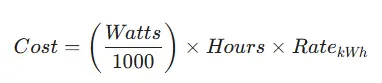
In the United States, electricity rates vary significantly by state. For instance, in 2025, rates in Hawaii can exceed 41 cents per kWh, while North Dakota remains closer to 11 cents. The national average sits at approximately 17 to 20 cents per kWh.
| State/Region | Rate per kWh | Monthly Cost (1500W) | Monthly Cost (250W) | Monthly Savings |
| Hawaii | $0.411 | $147.96 | $24.66 | $123.30 |
| California | $0.324 | $116.64 | $19.44 | $97.20 |
| New York | $0.290 | $104.40 | $17.40 | $87.00 |
| National Average | $0.171 | $61.56 | $10.26 | $51.30 |
| Texas | $0.153 | $55.08 | $9.18 | $45.90 |
| North Dakota | $0.111 | $39.96 | $6.66 | $33.30 |
Calculations based on 8 hours of daily use over 30 days.
The table demonstrates that in a high-cost market like Hawaii or California, the transition from a standard 1,500W heater to a 250W personal unit like the Honeywell Heat Bud can save an occupant over $90 to $120 per month. For those working from a home office, these savings often cover the initial purchase price of the heater within the first month of operation.
Analysis of Leading Low-Wattage Models (200W to 700W)
The market for low-wattage heaters is divided into several specialized niches, ranging from ultra-compact “Heat Buds” for desktop use to slim oil-filled radiators for silent, long-term warming.
The 200W Tier: Lasko MyHeat Personal Ceramic Heater
The Lasko MyHeat (Model 101) represents the absolute entry point for electric space heating. Consuming only 200 watts, it draws approximately 1.7 amps, making it almost impossible to trip a circuit breaker even in older buildings with 15-amp circuits.
The 250W Tier: Honeywell Heat Bud (HCE100)
The Honeywell Heat Bud is a ceramic personal heater that offers two heat settings: a 170-watt low setting and a 250-watt high setting.
The 320W-400W Tier: Radiant Panels and Silent Oil Radiators
This tier is characterized by a shift from fan-forced ceramic units to silent radiant and convection technologies.
The 500W-700W Tier: Amazon Basics and Costway Radiators
As wattage increases toward the 700W mark, the heaters move from personal “spot” warmers to units capable of heating small rooms or bathrooms.
Safety Certifications and Regulatory Compliance
For any consumer, understanding safety certifications is vital to preventing residential fires. In North America, the primary safety marks are UL (Underwriters Laboratories), ETL (Intertek), and CSA (Canadian Standards Association).
NRTL Explained: UL vs. ETL vs. CSA
A common misconception is that the UL mark is superior to ETL or CSA. In fact, all three are Nationally Recognized Testing Laboratories (NRTLs) approved by OSHA.
| Certification | Organization | Significance |
| UL Listed | Underwriters Laboratories | Tested to UL’s proprietary safety standards. Highly recognized in the US. |
| ETL Listed | Intertek (Edison Testing) | Tested to the exact same UL standards as UL-listed products. Equally accepted by AHJs. |
| CSA Mark | CSA Group | Meets standards for safety in Canada. The “CSA-US” mark shows compliance with US standards. |
These marks indicate that a third party has verified the heater’s design against fire, shock, and casualty hazards. Most reputable low-wattage heaters, including models from Honeywell, Lasko, and Dreo, carry at least one of these certifications.
Primary Safety Features in Modern Heaters
- Tip-Over Protection: A sensor or mechanical switch that automatically shuts off the unit if it is knocked over. This is standard on the Honeywell Heat Bud and Amazon Basics 500W.
- Overheat Protection: A thermal cutout that kills power if the internal temperature exceeds safe limits, often caused by a blocked intake vent.
- Cool-Touch Housing: The use of flame-retardant materials (like V-0 rated plastics) that ensure the exterior does not become hot enough to cause burns.
- Automatic Shut-off Timers: Units like the Whisper Heat and some Dreo models include timers (often 1–12 hours) to ensure the heater does not run indefinitely if forgotten.
The Role of Smart Technology and ECO Modes
The most recent innovation in low-wattage heating is the integration of digital thermostats and variable wattage “ECO” modes. Models such as the Dreo Atom 316 and Solaris H3 provide a hybrid approach.
- Dynamic Power Modulation: Instead of just having a “high” or “low” setting, smart heaters allow the user to set a specific temperature (e.g., 72°F). The heater then uses an algorithm to determine the minimum wattage required to maintain that temperature. As the room approaches the target, the heater might drop from 1,500W to 900W and eventually to a low maintenance mode of 600W or less.
- Energy Savings: Dreo claims that their “Smart ECO” mode can save up to 40% on energy costs by avoiding the “overshoot” common with mechanical thermostats. This technology leverages DC motors, which are quieter and more efficient than the AC motors used in traditional fan-forced heaters.
Specialized Environments: RVs and Offices
Two specific environments have become the primary markets for low-wattage heating: the professional office and the recreational vehicle.
Office Cubicles and “Air Wars”
In shared office spaces, central thermostats are often locked or set to temperatures that do not satisfy every occupant. Personal heaters under 500W solve this problem without overwhelming the building’s electrical infrastructure. Because a 200W heater like the MyHeat draws only about 1.7 amps, facility managers are more likely to approve their use compared to 1,500W units that draw 12.5 amps and frequently trip shared breakers.
RV and Camper Van Efficiency
RVs typically operate on 30-amp or 50-amp electrical systems. On a 30-amp system (3,600 total watts), running a 1,500W space heater leaves very little room for other essential appliances like the microwave, coffee maker, or water heater. Low-wattage units like the NewAir 400W or Costway 700W are essential for “off-grid” or “limited-shore-power” scenarios, allowing the occupant to maintain warmth overnight without risking a power failure.
Analysis of Heat Types and Their Pros/Cons
Choosing the right heater involves matching the heater type to the specific room conditions.
| Heater Type | Best For | Advantages | Disadvantages |
| Ceramic Fan-Forced | Offices, small rooms | Fast heat-up, portable, safety features. | Can be noisy, dries out air, heat dissipates quickly. |
| Oil-Filled Radiator | Bedrooms, nurseries | Silent, maintains heat after shut-off, steady warmth. | Slow to heat up, heavy, exterior becomes very hot. |
| Radiant/Infrared | Desk use, drafty areas | Instant warmth, ignores drafts, silent. | Directional (only heats what it faces), no residual heat. |
| Mica/Panel Heaters | Wall-mount, tight spaces | Slim profile, silent, efficient convection. | Less common in low wattage, can be expensive. |
The Future of Supplemental Heating: DC Motors and Automation
The landscape of low-wattage heating is moving toward greater integration with smart home ecosystems.
- Voice Control and Apps: Wall-mounted smart heaters, like those from Dreo, can now be controlled via Alexa or Google Assistant, allowing users to schedule heating cycles so the room is warm before they enter.
- DC Motor Efficiency: The transition from AC to DC motors in tower fans and heaters allows for much finer control over airflow, further reducing energy waste and operating noise.
- Motion Sensors: Some high-end models now include motion sensors that automatically shut the heater off if no movement is detected for a set period, addressing one of the biggest safety risks: leaving a heater running in an empty room.
If you are deciding between high and low heat settings, see our 1500W vs 750W space heater comparison for heat output, circuit load, and operating cost.


