

You are sitting in your living room on a freezing Tuesday evening. The central heat is running, but you still feel a chill deep in your bones. You decide it is time to buy a portable unit, but you quickly realize there are two main types on the shelf. One claims to heat the air, while the other claims to heat you directly. You want to spend your money wisely, so you start to wonder about Convection vs Radiant Space Heater Which Feels Warmer for your specific home. For the buying decision behind this topic, compare our Best Convection Space Heaters for. If this symptom or maintenance issue applies, Why Some Space Heaters Feel Hot but Heat Less covers the likely causes and safe checks.
This is a classic dilemma for anyone trying to survive a long winter. Choosing the wrong type of heat can leave you feeling frustrated. You might end up with a room that is warm at the ceiling but freezing at your feet. Or, you might get a heater that makes your skin feel hot while the rest of the room stays like an ice box.
As an experienced reviewer of heating technology, I have spent years testing both styles in real world conditions. The answer to which one “feels” warmer depends entirely on where you are sitting and how your room is built. Let us break down the science of comfort so you can make the right choice for your household.
Paid link. As an Amazon Associate, we earn from qualifying purchases at no extra cost to you.
TL;DR
- A radiant heater feels warmer immediately because it sends direct heat waves to your skin, similar to standing in the sun.
- The better heater depends on whether you value fast direct warmth, steadier whole-room comfort, quiet operation, portability or precise controls.
- For electric resistance heaters with the same wattage, electricity draw while the element is on is broadly similar; comfort and total runtime create the practical differences.
- Match the heater type to the room size, insulation and how long you normally occupy the space.
Quick Answer: Which Heater Feels Warmer?
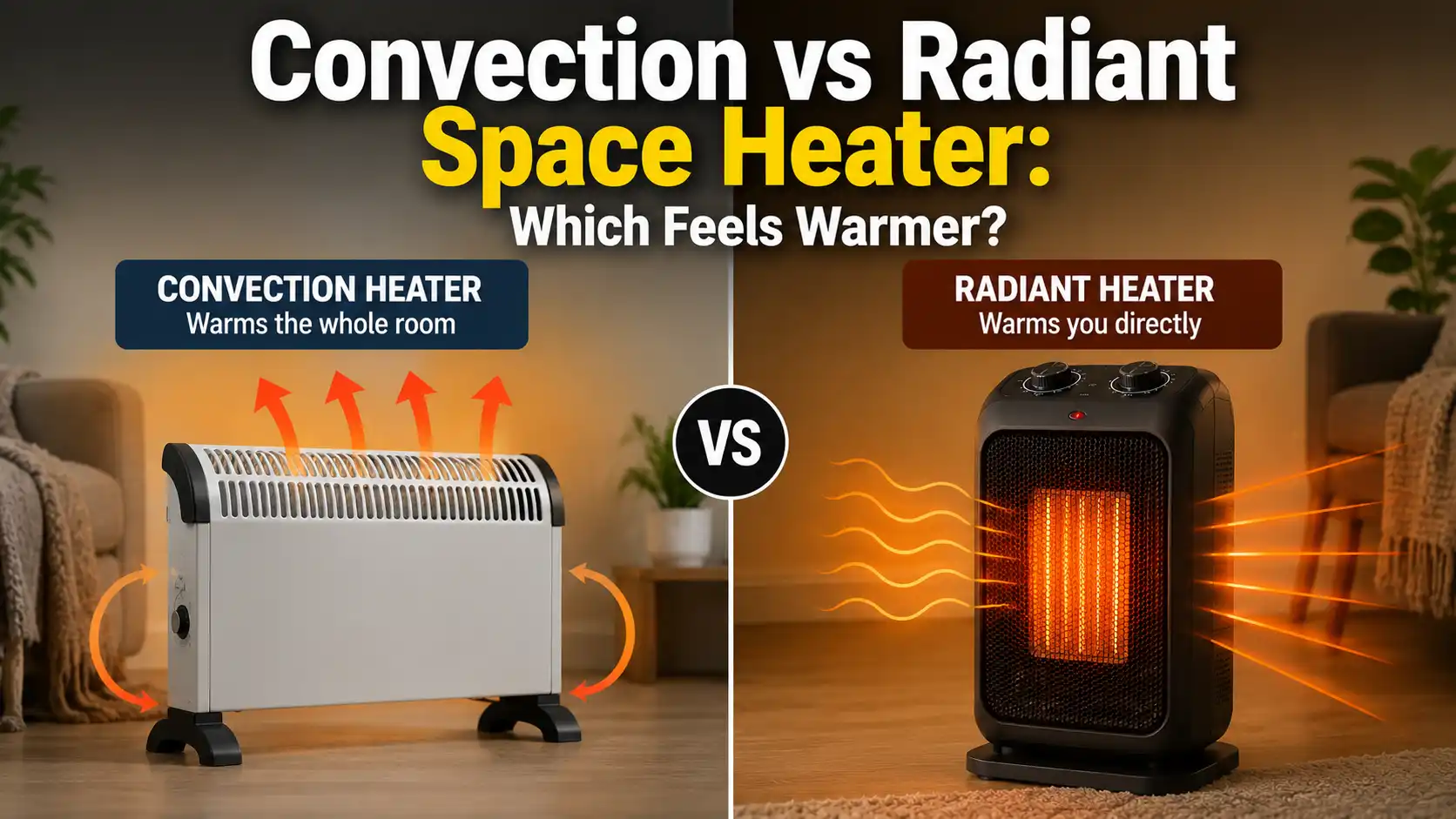
A radiant heater feels warmer immediately because it sends direct heat waves to your skin, similar to standing in the sun. However, a convection heater feels warmer over time because it raises the overall temperature of the air in the entire room. If you are sitting still in a large, drafty space, radiant heat will feel much more intense.

How Radiant Heaters Work: Direct Heat
To understand Convection vs Radiant Space Heater Which Feels Warmer, you have to look at the physics of infrared light. Radiant heaters do not focus on the air. Instead, they emit electromagnetic waves that only turn into heat when they hit a solid object.
Think of a campfire on a snowy night. The air around you is freezing, but your face feels hot. That is radiant heat. These units often use quartz tubes or carbon filaments that glow orange. The heat travels in a straight line. If you are in that line, you feel instant warmth. If you step to the side, the warmth vanishes.

How Convection Heaters Work: Air Circulation
Convection heaters take a completely different approach. They are designed to warm the air molecules themselves. Most of these units use a ceramic element or metal coils. They pull cold air in from the floor, heat it up, and then push it out.
Since hot air is lighter than cold air, it rises to the ceiling. As it cools, it sinks back down to be reheated. This creates a “loop” of moving air that slowly fills the entire room. You won’t feel a sudden blast of intense heat on your skin, but the whole room will eventually feel cozy and balanced.

Key Features to Consider
When shopping for a unit, keep these features in mind. They can change how the heat feels in your home.
Fans and Noise
Most convection heaters use fans. While this helps move the air faster, it also creates noise. If you want a silent room, you should look for a radiant heater or a “natural” convection unit like an oil-filled radiator.
Thermostat Accuracy
Convection heaters usually have better thermostats. Since they are measuring the air temperature, they can cycle on and off very precisely. Radiant heaters often stay “on” constantly because the air around them stays cool even if you are already sweating. For more detail on this topic, see our guide to what is a radiant space heater and how it works.
Pros and Cons of Radiant Heating
Pros
- Instant Heat: You feel the warmth the second you turn it on.
- Energy Efficient for One Person: You only heat yourself, not the whole room.
- Silent: Most do not use fans.
- Great for Outdoors: These work well on porches or in garages.
Cons
- Safety Risks: The front grilles get extremely hot and can cause burns.
- Limited Range: You have to stay in the “line of sight” to feel warm.
- No Residual Heat: The room gets cold the moment you turn it off.
Pros and Cons of Convection Heating
Pros
- Whole Room Warmth: It eliminates cold spots in the corners.
- Safer for Kids: The outer housings usually stay cooler to the touch.
- Thermostat Control: It maintains a steady temperature all day.
- Long Lasting Comfort: The air stays warm even after the unit cycles off.
Cons
- Slow Start: It can take 20 to 30 minutes to feel the difference.
- Drying Air: Fans can dry out your skin and eyes.
- Inefficient in Open Spaces: High ceilings swallow the warm air.
Cost Breakdown: Which Is Cheaper?
When looking at Convection vs Radiant Space Heater Which Feels Warmer, many people worry about their electric bill. In 2026, energy prices are a major concern.
Almost all portable heaters use 1,500 watts on their high setting. This means they cost the same amount of money to run for an hour. However, the perceived value is different.
A radiant heater is cheaper if you only need to be warm for 15 minutes. A convection heater is cheaper if you plan to stay in the room for five hours. This is because the convection heater’s thermostat will eventually turn the unit off once the air is warm. The radiant heater will likely run the entire time. For related troubleshooting, see why some space heaters feel hot but heat less.
Safety Considerations
Safety is the most important factor in any heater review. Both styles have specific risks.
Radiant heaters are a higher fire risk for curtains and furniture. Because the heat is so intense in one direction, it can scorch fabrics if they are too close. You must maintain at least a three foot clearance at all times.
Convection heaters are generally safer for pets and children. However, they can still overheat if the intake vents get clogged with dust or pet hair. Always look for units with tip-over switches and overheat protection sensors.
Comparison Insights: Which Should You Buy?
Who Should Buy a Radiant Heater?
- People who work in garages or basements.
- Anyone who wants instant warmth after coming in from the cold.
- Households with high ceilings or drafty windows.
- Single people who spend most of their time in one chair.
Who Should Buy a Convection Heater?
- Families with children or pets.
- People who want to heat a bedroom for the entire night.
- Anyone who is sensitive to “hot spots” and wants even temperature.
- Users who want a set-it-and-forget-it thermostat.
Buying Factors to Watch For
Before you click the buy button, check these three things.
- Wattage Settings: Look for a unit with “Low” and “Medium” settings. 1,500 watts is a lot of power. Being able to drop down to 750 watts will save you money and prevent your skin from feeling too dry.
- Safety Certifications: Ensure the unit has a UL or ETL seal. This proves it has been tested by independent labs for fire safety.
- Warranty Length: A one year warranty is standard, but some premium brands offer three or five years. Since heaters have moving parts and high heat, a longer warranty is a big plus.
Practical Tips
- The Hand Test: If you can’t feel the heat from your radiant heater from four feet away, it is likely too small for your needs.
- Clear the Intake: Vacuum the back of your convection heater once a month. Dust buildup makes the fan work harder and uses more electricity.
- Angle Your Heat: Point radiant heaters at your chest, not your face. This prevents your eyes from getting dry and itchy.
- Shut the Door: Zone heating only works if you keep the room sealed. Don’t let your expensive heat wander into empty hallways.
Common Mistakes to Avoid
One of the biggest mistakes is putting a convection heater right next to a window. The glass will cool the air down as fast as the heater warms it up. Put the heater on an interior wall instead.
Another mistake is buying a radiant heater for a nursery. Children move around too much to stay in the heat beam. They might also touch the hot grille. A convection heater or an oil-filled radiator is a much safer and more comfortable choice for kids.

Frequently Asked Questions
Can a radiant heater heat a whole room?
Technically, yes, but it takes a very long time. Radiant heaters only heat the objects they “see.” Eventually, those objects will give off a little bit of heat to the air, but it is much less efficient than a convection unit for this purpose.
Is convection heat safer than radiant heat?
Generally, yes. Convection heaters have lower surface temperatures and don’t create “hot spots” that can ignite nearby fabrics as easily. However, both must be used with caution and kept away from flammable materials.
Why does my radiant heater smell like burning?
This is usually dust or hair that has landed on the glowing elements. Because radiant elements get much hotter than convection ones, they burn off debris instantly. Always clean your heater before the first use of the season.
Which heater is better for allergies?
Radiant heaters are better for people with allergies. Convection heaters use fans that can blow dust, pet dander, and pollen around the room. Since radiant heaters don’t move air, they keep your environment cleaner.
Do infrared heaters dry out the air?
No. Infrared heaters do not heat the air directly, so they do not lower the humidity as much as convection heaters do. If you struggle with dry skin or a scratchy throat in the winter, a radiant infrared heater is a great choice.
Can I leave a convection heater on all night?
No portable space heater should be treated as safe to leave running while you sleep or when it is unattended. CPSC recommends turning portable heaters off when sleeping, plugging electric heaters directly into a wall outlet, and keeping them at least three feet from bedding, curtains, furniture, and other combustible materials.
What is the most energy efficient type of heater?
Both use the same amount of electricity (1,500 watts). However, radiant heat is more efficient for “spot heating” one person, while convection is more efficient for “zone heating” a room for a long period.
For a current radiant product example, our Comfort Zone quartz heater review covers a fan-assisted three-element design.


