
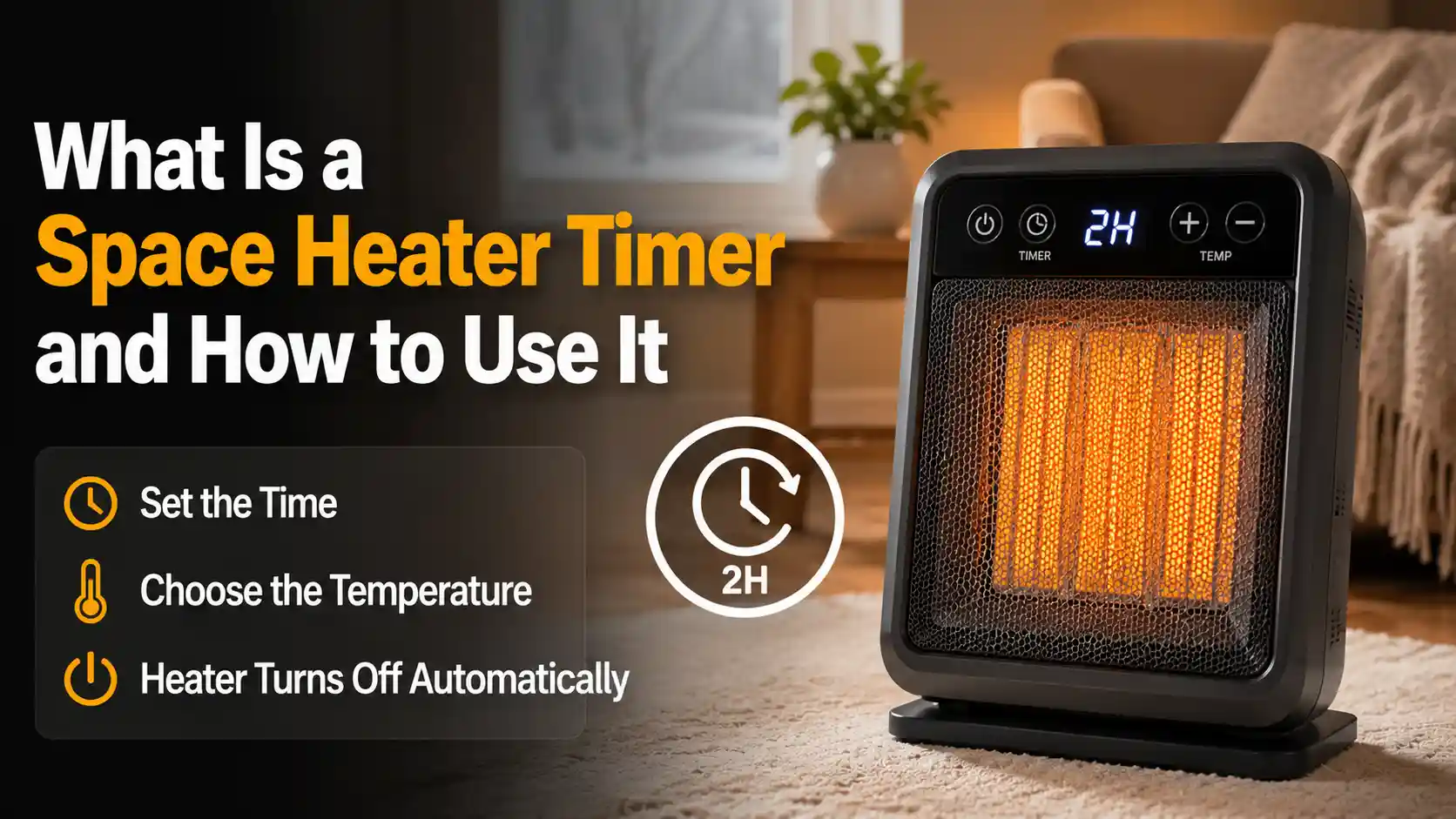


A space heater timer is a built-in control that turns the heater off after a selected period or, on some models, schedules a delayed start. It is useful for limiting runtime, but a timer does not make unsafe placement or unattended operation safe.
If you want a space heater with a timer to turn on, verify that the exact model supports delayed start. Many heaters only have an auto-off countdown. External plug-in timers are a different product and should not be used unless both the timer and heater manufacturer explicitly allow the high electrical load.
The safest and simplest option is usually a heater with a built-in timer, thermostat and the normal tip-over and overheat protections required for your use case.
Paid link. As an Amazon Associate, we earn from qualifying purchases at no extra cost to you.
TL;DR
- A space heater timer is a built-in control that turns the heater off after a selected period or, on some models, schedules a delayed start.
- A built-in timer can reduce unnecessary runtime, but it is not permission to leave a portable heater unattended or run it while sleeping.
- Avoid generic plug-in timers unless the heater manufacturer permits them and the timer is explicitly rated for the heater’s load.
- For energy savings, a thermostat plus a sensible timer usually matters more than the timer alone.
What Is a Space Heater Timer?
A space heater timer is a built-in control or external device that automatically shuts off the heater after a set amount of time. It allows you to program the unit to run for specific intervals, such as one to twelve hours, ensuring the heater does not run indefinitely.


How Space Heater Timers Work
To understand what is a space heater timer and how to use it, you need to look at the two different types of timers available. Most modern heaters come with a built-in digital timer. These are part of the internal control board. You simply press a button to select how many hours you want the heater to run before it kills the power.
The second type is an external plug-in timer. These are separate devices that sit between your wall outlet and the heater cord. They work by physically cutting the electricity to the outlet at a specific time. While these were popular for older heaters, many modern units with digital buttons will stay in “standby” mode if the power is cut and restored. This is why a built-in timer is almost always the better choice for modern homes. For the electricity and running-cost side of this topic, see What is Eco Mode on Space Heater? Saving Money While Staying Warm.
Inside the heater, the timer acts like a countdown clock. When the clock hits zero, a relay switch opens. This breaks the electrical circuit and stops the heating elements and fan instantly. It is a simple but effective way to prevent the unit from overworking or heating an empty house.
Auto-Off vs Delayed-Start Heater Timers
Heater technology has improved significantly. Today, timers do more than just count down. They are designed to fit into your specific lifestyle.
Delayed Start Timers
Some high-end units allow you to set a “delayed start.” This means you can program the heater at 7:00 AM to turn on at 4:30 PM. When you walk through the door after work, your living room is already toasty. This is a great way to use “zone heating” without having to wait for the air to warm up.
Auto-Shutoff Intervals
Most standard heaters offer intervals like 1, 2, 4, or 8 hours. Some digital models allow you to set the time down to the minute. This flexibility is perfect for situations like warming up a bathroom before a shower or taking the chill off a bedroom before you fall asleep.
Remote Control Integration
In the world of 2026, many heaters come with remotes that allow you to set the timer from across the room. You don’t even have to get up from the sofa to ensure the heater will turn off by itself later that evening.
How to Set a Built-In Space Heater Timer
Using a timer is usually very straightforward. However, every model is a little different. Here is the general process for most digital heaters.
Step 1: Turn the Heater On
Most timers will only work when the main power is already engaged. Press the power button and set your desired temperature first.
Step 2: Locate the Timer Button
Look for a button with a clock icon or the word “Timer.” On many units, this button is shared with other functions, so you might need to hold it down for a second.
Step 3: Select Your Duration
Each press of the button will usually increase the time by one hour. The display will flash the number of hours you have selected. Once the flashing stops, the timer is set and the countdown begins.
Step 4: Verify the Indicator
Most heaters will have a small LED light next to the timer button to show that the countdown is active. If that light is on, you can relax knowing the heater will shut itself down later.
Is It Safe to Put a Space Heater on a Timer?
While learning what is a space heater timer and how to use it, you must remember that a timer is a convenience tool, not a replacement for active safety.
- Never Leave the House: Even if you have a timer set to turn off in 20 minutes, you should never leave a heater running in an empty house. If the unit tips over or a pet knocks something against it, a fire can start before the timer hits zero.
- The Three-Foot Rule: Always maintain three feet of clearance around the heater. Just because it is on a timer doesn’t mean it won’t get hot enough to ignite curtains or bedding.
- Check the Plug: Heaters pull a lot of power. If you use an external plug-in timer, ensure it is rated for at least 1,500 watts. A cheap lamp timer will melt and potentially cause a fire if used with a space heater.
What to Look For in a Heater With a Timer
When looking for a unit with a good timer, keep these factors in mind.
- Precision: Look for units that allow for 1-hour increments. Some older models only have “Short” or “Long” settings, which are less helpful.
- Memory Function: Some smart heaters will remember your timer settings. This is great if you always want the heater to run for exactly two hours every evening.
- Visibility: Ensure the countdown is easy to read from a distance. You want to be able to glance at the heater and know exactly how much time is left.
Frequently Asked Questions
Can I add a timer to a heater that doesn't have one?
You can use a heavy-duty plug-in timer rated for 15 amps or 1,800 watts. However, many modern digital heaters will not turn back on automatically when the power is restored. They will just sit in standby mode. This is why built-in timers are much more effective.
Is it safe to leave a heater on a timer while I sleep?
No portable space heater should be treated as safe to leave running while you sleep or when it is unattended. CPSC recommends turning portable heaters off when sleeping, plugging electric heaters directly into a wall outlet, and keeping them at least three feet from bedding, curtains, furniture, and other combustible materials.
What is the difference between a timer and a thermostat?
A thermostat turns the heater on or off based on the temperature of the room. A timer turns the heater off based on how much time has passed. Using both together is the best way to be efficient and comfortable.
Will a timer prevent a fire?
A timer can prevent a fire by ensuring a heater doesn’t run for days if you forget it. However, it cannot prevent a fire if the heater tips over or is too close to a curtain while it is running. You still need to follow all safety rules.
Why did my external timer melt?
Most likely, the timer was not rated for the high wattage of a space heater. Heaters pull about 12.5 to 15 amps. If your timer was only rated for 10 amps (common for lamps), it will overheat and melt very quickly.
Do smart plugs work as space heater timers?
Only if they are specifically rated for 15 amps. Most cheap smart plugs are not built for heaters. Even if they are, many digital heaters won’t restart on their own after a smart plug turns the power back on.
Can a timer help with "new heater smell"?
Yes. If you have a new heater, you can set it to run for two hours in a garage or a room with open windows. The timer will ensure it burns off the factory coating without you having to sit there and watch it.


