

The onset of the winter season presents a significant challenge for maintaining comfort within the residential environment. Many heating systems fail to address the specific needs of individual rooms, leading to uneven temperatures and high energy costs.
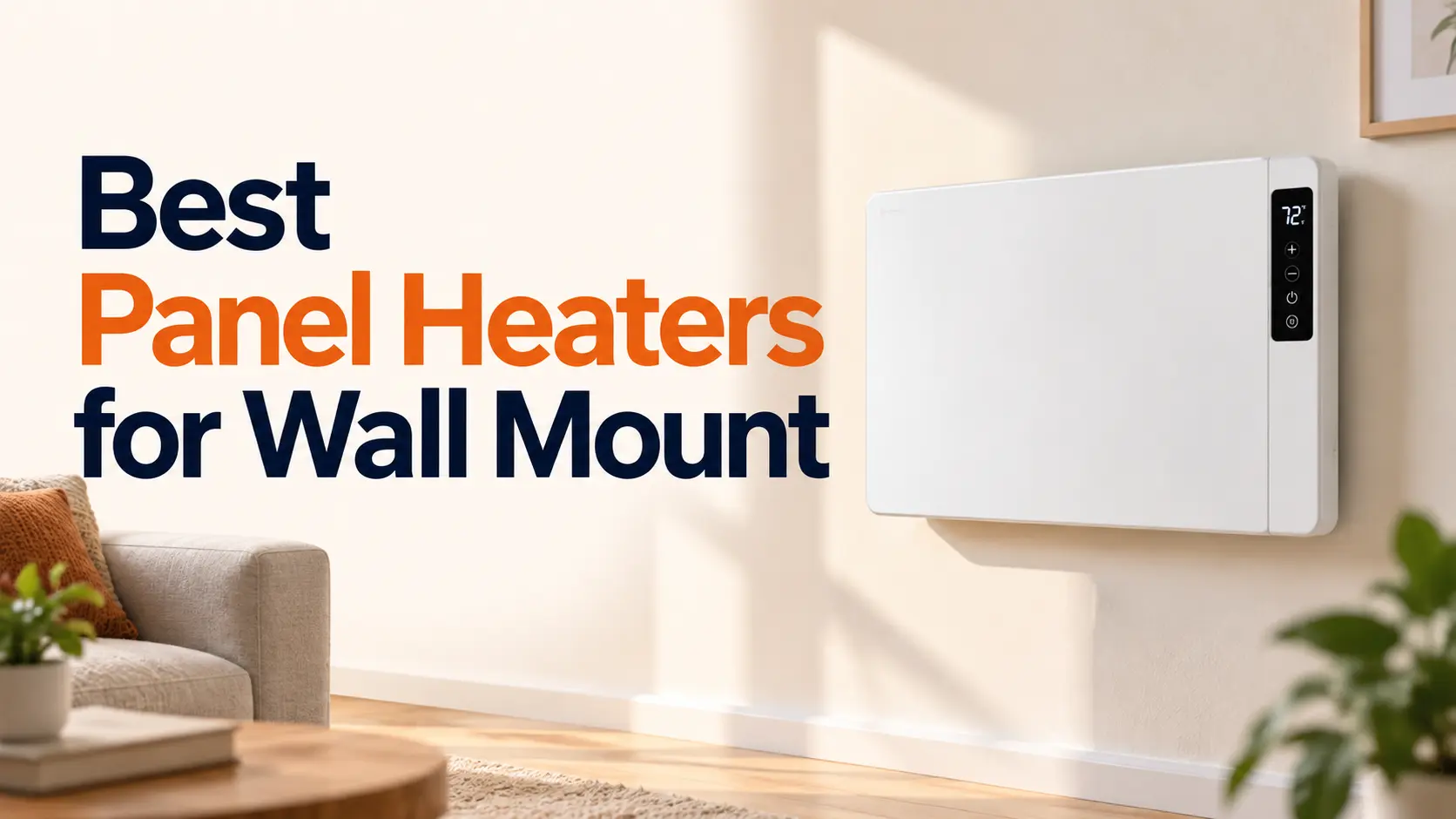
This report evaluates the best panel heaters for wall mount to provide clear guidance on space saving and efficient heating solutions. It examines the market trends, technical mechanisms, and practical considerations that define modern wall-mounted heating technology.
For model-specific comparisons within wall-mounted panel heaters, see our Cadet Com-Pak CSC151TW Wall Heater Review and Heat Storm HS-1500-PHX-WIFI Review. Both reviews cover controls, safety features, heating style, and where each design fits best.
Paid link. As an Amazon Associate, we earn from qualifying purchases at no extra cost to you.
TL;DR
- The following table provides a scannable summary of the top-performing wall-mounted panel heaters available in the current market.
- Choose by the room and use case first, then compare wattage, thermostat control, noise, safety features, size and current warranty/model details.
- A higher price does not automatically mean lower electricity use; for electric resistance heaters, runtime and thermostat control matter more than marketing claims.
- Before buying, verify the exact model, safety listing, current price and manufacturer instructions because retailer listings can change.
Quick Picks for Efficient Wall Heating
The following table provides a scannable summary of the top-performing wall-mounted panel heaters available in the current market. These selections are based on performance metrics, safety features, and user satisfaction scores.

| Product Name | Best For | Key Strength | Quick Link Text |
| DeLonghi HMP1500 | Large Bedrooms | Rapid room-wide warmth | Check Price on Amazon |
| Envi Gen 3 LE5012P | Nurseries and Offices | Silent and cool-touch surface | Check Price on Amazon |
| Heat Storm Phoenix | Smart Home Integration | Wi-Fi and infrared efficiency | Check Price on Amazon |
| Dreo WH719S | Bathrooms | IP24 waterproof safety | Check Price on Amazon |
| EconoHome 400W | Budget Energy Savings | Low power and paintable design | Check Price on Amazon |
| Mill Invisible | Minimalist Decor | Precise Norwegian smart tech | Check Price on Amazon |
| Boldr Kelvin | Aesthetic Spaces | Sleek design and smart app | Check Price on Amazon |
| Stiebel Eltron CK | Cold Bathrooms | High BTU for quick heat | Check Price on Amazon |
| King Electric KCV | Large Studios | Durable maintenance-free build | Check Price on Amazon |
| Broan-NuTone 198 | Garages and Workshops | High capacity 4000W output | Check Price on Amazon |


Market Evolution and Buyer Psychology
The transition from portable floor heaters to permanent wall-mounted panels reflects a broader shift in consumer priorities. Homeowners now value floor space more than ever. This is especially true in urban settings where every square foot matters. Wall-mounted heaters provide a sleek and integrated look that complements modern interior design.
A primary driver for this change is safety. Traditional space heaters are often viewed as a tip-over hazard, especially in homes with small children or pets. By mounting a heater to the wall, a buyer removes the risk of the unit falling over. This creates a safer environment while providing a more consistent heat source.
Another factor is the rise of zonal heating. Rather than running a central furnace for the whole house, buyers prefer to heat only the rooms they are using. This method can lower energy bills by thirty to fifty percent. The psychological comfort of knowing exactly how much energy is being consumed is a major selling point for modern smart heaters.
Technical Buying Guide for Panel Heaters
Choosing the right heater involves more than just picking a brand. A buyer must match the heater’s output to the room’s specific needs.
Sizing and Wattage Calculation
The standard calculation for heating is ten watts of power for every square foot of space. This assumes average eight-foot ceilings and standard insulation. If a room has very high ceilings or many windows, more power will be needed.
| Room Size (sq ft) | Recommended Wattage | Best Heater Type |
| 50 – 100 | 500W – 750W | Convection or Small Infrared |
| 100 – 150 | 1000W – 1200W | Mica-thermic or Ceramic |
| 150 – 200 | 1500W | Mica-thermic or High-End Convection |
| 200 – 300 | 2000W | Large Convection or Multiple Units |
| 300+ | 3000W+ | 240V Hardwired Unit |
For rooms with poor insulation, it is better to choose an infrared heater. These warm the people in the room directly, so the heat is not lost to drafty walls or windows as quickly.
Voltage Requirements: 120V vs 240V
Most plug-in panel heaters use 120 volts. These are easy to install and can be moved if needed. However, they are generally limited to 1500 watts. Hardwired 240-volt heaters are more efficient for large spaces. They can provide much more heat and do not require a visible power cord. A 240-volt unit will need a professional electrician to install a dedicated circuit breaker. For more detail on this topic, see our guide to what is a panel space heater for wall mounting.
Safety Certifications and Features
Safety is the most important factor when buying a heater that will be mounted permanently to a wall. Buyers should look for the following features.
- Overheat Protection: A sensor that shuts off the heater if it gets too hot.
- Safe-Touch Surfaces: Crucial for homes with children. These units do not get hot enough on the outside to cause burns.
- Wall-Sens Technology: Shuts off the heater if it is taken off the wall.
- IP Ratings: Essential for bathroom use. An IP24 rating means the unit can handle water splashes.
- UL and ETL Marks: These show that the heater has been tested by independent labs to meet strict safety standards.
Practical Installation and Placement Tips
Where a heater is placed on the wall is just as important as how much power it has. Incorrect placement can lead to wasted energy and cold spots in the room.
Vertical Placement and Airflow
Heat naturally rises. If a convection heater is mounted too high on a wall, the warm air will stay near the ceiling while the floor remains cold. For most panel heaters, the ideal mounting height is between six and twelve inches from the floor. This allows the unit to pull in the coolest air from the bottom of the room and push warm air out into the living space. For a deeper look at this heater type, see our What Is a Panel Space Heater for Wall Mounting.
Clearances and Obstructions
A heater needs space to “breathe.” If a heater is blocked by a sofa, curtains, or a door, the heat cannot circulate. A buyer should follow these clearance rules.
| Type of Clearance | Minimum Requirement | Reason |
| Floor to Bottom | 4.5 – 12 inches | Cool air intake |
| Top to Ceiling | 12 – 18 inches | Heat dispersion |
| Sides to Walls | 6 – 12 inches | Air circulation |
| Front to Objects | 3 feet | Fire safety |
Specific Room Placement
In a garage or workshop, it is best to mount the heater on a back wall and angle it toward the main workspace. In a bedroom, the heater should be placed away from the bed to avoid direct heat during sleep. For bathrooms, the heater must be installed far away from water sources like tubs and sinks.
Economic Impact and Energy Costs
Understanding the cost to run a heater is vital for a smart buyer. Most panel heaters use between 500 and 1500 watts. The average cost for electricity in the United States is around 17 cents per kilowatt-hour.
Using this average, a 1500-watt heater costs about $0.26 per hour to run on high. A 1000-watt heater costs about $0.17 per hour. If a person runs a 1000-watt heater for four hours a day, it will add about $20 to their monthly bill.
Costs can vary widely by state. In Hawaii, where electricity is expensive, the monthly cost for the same heater could be over $45. In North Dakota, where rates are lower, the cost might be only $13. Zonal heating with panel heaters is most effective when the main home thermostat is lowered to 62 degrees while the occupied room is kept at 70 degrees. This can save forty to sixty dollars a month on central heating costs.
Who Should Purchase a Wall-Mounted Panel Heater?
These heaters are ideal for many different situations.
- Apartment Renters: Plug-in models are easy to install and do not require permanent changes to the building. They can be taken to a new home when moving.
- Families with Toddlers: Removing the heater from the floor prevents kids from tripping over it or knocking it down.
- Remote Workers: Heating only the home office during the day is much cheaper than heating the whole house.
- Homeowners with Cold Bathrooms: A wall-mounted unit provides instant warmth on chilly mornings without taking up any floor space.
- People with Allergies: Fan-less convection and infrared heaters do not blow dust or pet hair around the room. This helps maintain better air quality.
Frequently Asked Questions
Are wall-mounted panel heaters energy efficient?
Yes, they are 100% efficient at converting electricity into heat. They are even more efficient when used for zonal heating. This means you only heat the room you are in rather than the whole house.
Can I leave a wall panel heater on all the time?
Many models like the Envi and Mill are designed for 24/7 background warmth. They have safety sensors to prevent overheating. However, it is always a good idea to set a schedule using a smart app to save money.
Do these heaters make noise?
Convection heaters like the Envi and EconoHome are completely silent because they have no moving parts. Some other models have small fans to help move the air. These are usually very quiet, like a soft hum.
How hard is it to install a wall heater?
Most plug-in models are very easy to install. They usually come with a mounting template and a few screws. A basic DIY setup usually takes less than fifteen minutes. Hardwired models will require a professional electrician.
Will the heater damage my wall or paint?
High-quality wall heaters have heat shields on the back to keep the wall cool. As long as you follow the manufacturer’s clearance rules, your wall and paint will stay safe.
Can I use a wall heater in the bathroom?
Yes, but you must choose a model with an IP24 or higher waterproof rating. It should be installed far away from water sources. Many people find that wall heaters are a great way to make a bathroom cozy.
Do I need a special outlet for a 1500W heater?
A 1500W heater should be used on a dedicated circuit if possible. This means you should not plug other large appliances into the same outlet or circuit at the same time to avoid tripping the breaker.


