
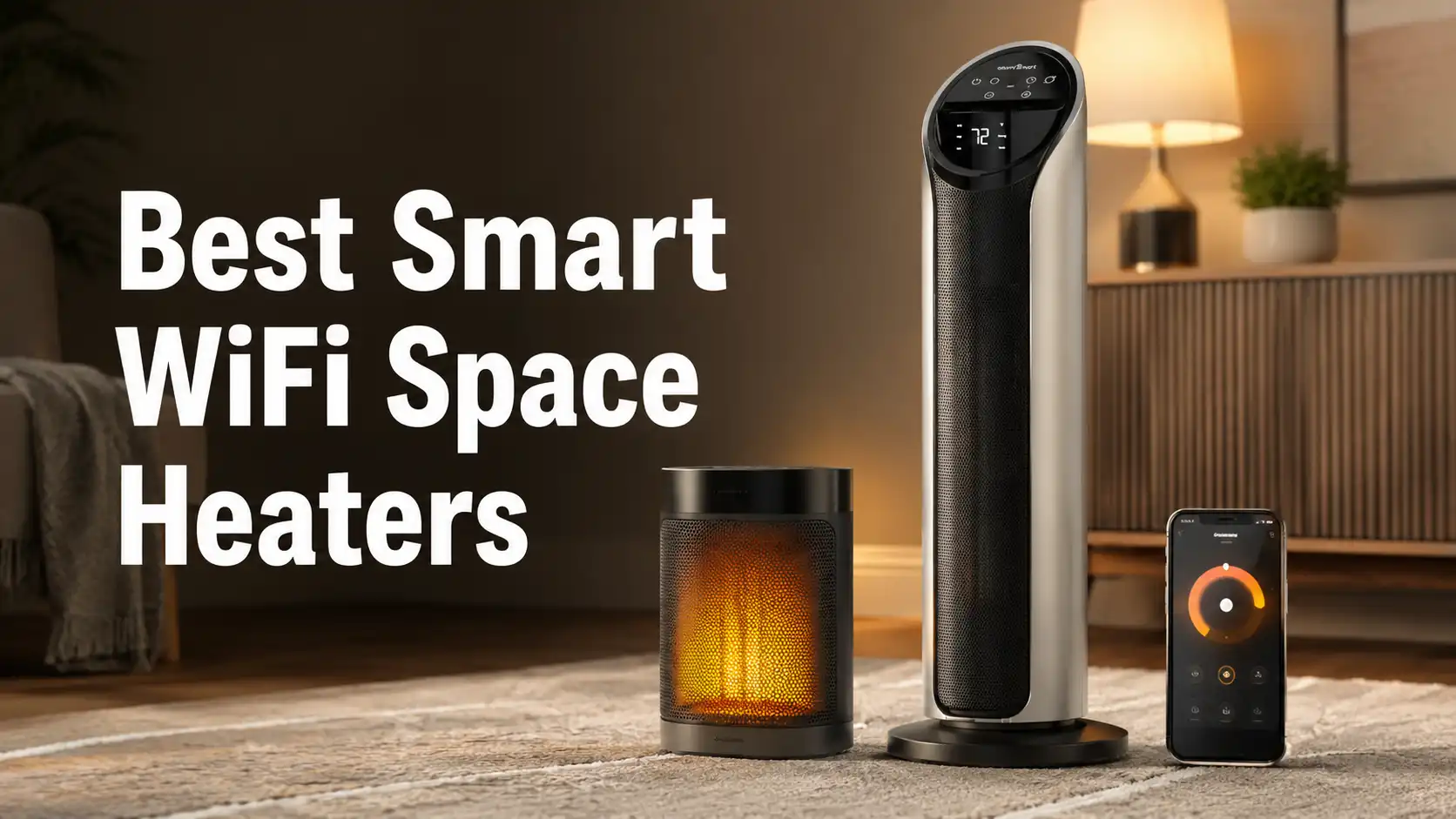

The transition from traditional resistive heating to the era of the Internet of Things (IoT) has redefined the domestic climate control landscape. As consumers increasingly prioritize granular control over their living environments, the smart space heater has evolved from a simple portable appliance into a sophisticated node within the modern smart home ecosystem. For closely related guidance, see our What Is a Smart WiFi Space Heater and How It Works.
This evolution is characterized by the integration of high-precision thermistors, variable-frequency drive logic, and complex wireless communication protocols that allow for seamless interaction with mobile applications and voice-activated assistants.
However, the market in 2026 is not defined solely by convenience; it is shaped by a rigorous new regulatory framework and a series of high-profile product recalls that have fundamentally altered the availability and functionality of connected heating devices.
Paid link. As an Amazon Associate, we earn from qualifying purchases at no extra cost to you.
TL;DR
- The transition from traditional resistive heating to the era of the Internet of Things (IoT) has redefined the domestic climate control landscape.
- Choose by the room and use case first, then compare wattage, thermostat control, noise, safety features, size and current warranty/model details.
- A higher price does not automatically mean lower electricity use; for electric resistance heaters, runtime and thermostat control matter more than marketing claims.
- Before buying, verify the exact model, safety listing, current price and manufacturer instructions because retailer listings can change.
The Regulatory Crisis: UL 1278 and the 2024-2025 Recalls
The most significant event in the smart heater industry over the past decade occurred in late 2024, when the U.S. Consumer Product Safety Commission (CPSC) and Health Canada issued a massive recall for smart space heaters produced by Govee and Atomi. This recall impacted approximately 600,000 units and exposed a critical gap between consumer demand for remote functionality and the safety requirements dictated by the UL 1278 standard.


Understanding the Hazards of Remote Operation
The core of the regulatory conflict lies in the risk associated with activating a high-wattage appliance when no one is present to monitor its surroundings. Space heaters account for approximately one-third of all winter house fires, often due to proximity to flammable objects like curtains or upholstery. Testing conducted by safety officials determined that the smart features of the Govee and Atomi units—specifically their ability to be turned on via a smartphone from a remote location—did not comply with the voluntary industry safety standard, UL 1278.
The 24-Hour Interaction Rule
As a response to these risks, the current version of UL 1278 for “connected” or “smart-enabled” appliances requires a physical “enablement” step. If a heater has not received a manual command or had its physical interface touched within a 24-hour window, the WiFi functionality must be disabled as a safeguard. This ensures that the user has verified the device’s environment before it can be operated remotely. This regulatory shift has led to significant consumer frustration, as many users purchased smart heaters specifically for the ability to pre-warm homes or greenhouses over long periods without physical access.
Technical Infrastructure: The WiFi Connectivity Challenge
The effectiveness of a smart heater is entirely dependent on the reliability of its wireless connection. Data from thousands of user reviews indicates that the vast majority of “defective” smart heaters are actually victims of poor network infrastructure or configuration errors.
The 2.4 GHz vs. 5 GHz Dilemma
Smart heaters, like many IoT devices, almost exclusively utilize the 2.4 GHz frequency. This band provides superior range and the ability to penetrate physical obstacles like drywall and furniture, which is critical for appliances placed at floor level or in basements. However, modern routers often use “band steering” to combine 2.4 GHz and 5 GHz signals under a single SSID name.
When a smart heater attempts to connect, it often struggles to authenticate with a router that is trying to steer it toward the faster but shorter-range 5 GHz band. This results in constant “offline” statuses or failed initial pairings. Expert setup recommendations involve temporarily disabling the 5 GHz band or creating a dedicated guest network that only broadcasts at 2.4 GHz with WPA2 security protocols.
Local vs. Cloud Control and Privacy
The 2024 recalls highlighted a major vulnerability in the smart heater market: cloud dependency. When Govee recalled their units, many were rendered “un-smart” overnight as the company could potentially disable app features via firmware updates to avoid liability. Advanced users have increasingly turned toward devices that support “Local Tuya” or Home Assistant integrations, which allow the heater to be controlled directly via the local home network without relying on the manufacturer’s external servers. This provides a layer of longevity and privacy that is becoming a key selling point for high-end consumers.
Advanced Safety Protocols and Fire Mitigation
Beyond the smart features, the physical safety mechanisms of a space heater are the most critical components of its design. In 2026, the presence of these features is a non-negotiable requirement for any unit sold on major retail platforms.
Physical Safety Mechanisms
- Tip-Over Switches: Modern units use either a mechanical pendulum switch or a digital accelerometer to detect if the unit has been tilted beyond 15 to 45 degrees. This immediately cuts power to the heating element to prevent a fire if the unit falls onto a carpet or rug.
- Thermal Overload Sensors: These internal fuses or thermistors monitor the air intake and the element itself. If the air intake is blocked by dust or a stray piece of clothing, the heater will shut down before the housing can melt or ignite.
- Fused Plugs and ALCI: Brands like Lasko include “Blue Plug” technology, which is a patented safety fuse built directly into the power cord. If the outlet experiences a short circuit or an amperage surge, the fuse in the plug will blow, protecting the home’s internal wiring from heat damage.
The Dangers of “Smart-i-fying” Dumb Heaters
A dangerous trend identified in online forums is the use of standard smart plugs to control older “analog” heaters. A 1500W space heater draws approximately 12.5 amps of current, which is near the maximum capacity of a standard 15-amp residential circuit. Most consumer-grade smart plugs are not designed for the continuous, high-wattage draw of a resistive heater.
User reports frequently cite incidents where smart plugs have melted, charred wall outlets, or sparked fires because their internal relay components were overloaded. The general consensus among fire safety professionals is that heaters must be plugged directly into a wall outlet, and any remote control functionality must be built into the appliance itself by the manufacturer. For the buying decision behind this topic, compare our Best Space Heaters with Remote Control for Easy Operation.
Economic Analysis: The Energy Efficiency of Smart Supplemental Heat
One of the primary arguments for purchasing a smart space heater is the potential for reduced utility bills. By heating only the occupied room rather than the entire home, users can significantly lower their primary furnace usage.
The “10 Watts Per Square Foot” Rule
In 2026, the industry standard for calculating heat requirements remains 10 watts per square foot of space for a room with standard 8-foot ceilings and average insulation.
- Small Bedroom (150 sq. ft.): 1500W is more than sufficient, often allowing the unit to run in a low-power ECO mode (750W) for the majority of the time.
- Large Living Area (300-500 sq. ft.): A 1500W unit will serve as supplemental heat, but a primary source (like a central furnace) is still required to maintain a baseline temperature.
Return on Investment (ROI) via Smart Scheduling
Smart heaters offer an efficiency advantage over “dumb” heaters through precise scheduling and geofencing. For example, a user who sets their smart heater to run for two hours in the morning and four hours in the evening—rather than leaving it on all day—can reduce their supplemental heating costs by up to 60%. Furthermore, the ECO mode logic found in Dreo and De’Longhi units prevents the “oscillation” of power where a heater constantly switches between 0 and 1500W, which is less efficient than maintaining a steady 600W to 800W output.
| Household Profile | Primary Heat Source | Smart Heater Use Case | Estimated Annual Savings |
| Work-from-Home | Central Gas Furnace | Heating a 100 sq. ft. office | 15-20% on Gas Bill |
| Small Apartment | Electric Baseboard | Zonal heating with Dreo Solaris | 25-30% on Electric Bill |
| Garage Gym | None | Spot heating with Heat Storm PHX | N/A (Comfort Focus) |
Future Outlook: The Next Generation of Smart Heating
As the industry moves toward 2026, the focus will shift from simple app control to AI-driven thermal optimization and the adoption of the “Matter” smart home standard.
AI-Optimized Thermal Envelopes
Future smart heaters are expected to integrate with home weather stations and smart blinds to adjust their output based on solar gain and external wind chill. By predicting when a room will naturally cool down, these heaters can pre-emptively cycle on at low wattages, further reducing energy consumption and mechanical wear on the heating elements.
The Integration of Matter and Local Control
The “Matter” protocol aims to solve the interoperability issues that plague current smart heaters. By providing a unified language for all smart home devices, Matter will allow a Dreo heater and a Dyson purifier to share temperature data from a third-party sensor, creating a truly automated environment. This move toward standardization will also likely include more robust local-control options, mitigating the risks of product obsolescence following a recall or company merger.
Summary of Best-in-Class Recommendations
The 2026 landscape for smart space heaters is one of high stakes and high technology. The following table synthesizes the final recommendations for professional and residential applications.
| Category | Recommended Model | Rationale |
| Best Overall | Dreo Solaris Slim H3 | Unmatched balance of quietness, precision, and app stability. |
| Best for Large Rooms | Lasko AR122 | 180° oscillation and presence sensing provide superior coverage for open floor plans. |
| Best for Smart Homes | Heat Storm HS-1500-PHX | Tuya/Smart Life integration makes it the best choice for complex automation. |
| Best for Bedrooms | Dreo OH310 (Oil-Filled) | Completely silent operation with robust smart scheduling capabilities. |
| Best Luxury/HEPA | Dyson HP09 | The only unit to combine smart heating with formaldehyde destruction and HEPA air purification. |
In the modern climate of 2026, the “smart” space heater has proven to be a resilient and essential appliance, surviving a massive regulatory shakeup to emerge as a more secure and efficient tool for home thermal management. Consumers who navigate this market by prioritizing certified safety standards and robust network configurations will find these devices to be indispensable assets in the pursuit of both comfort and sustainability.


