
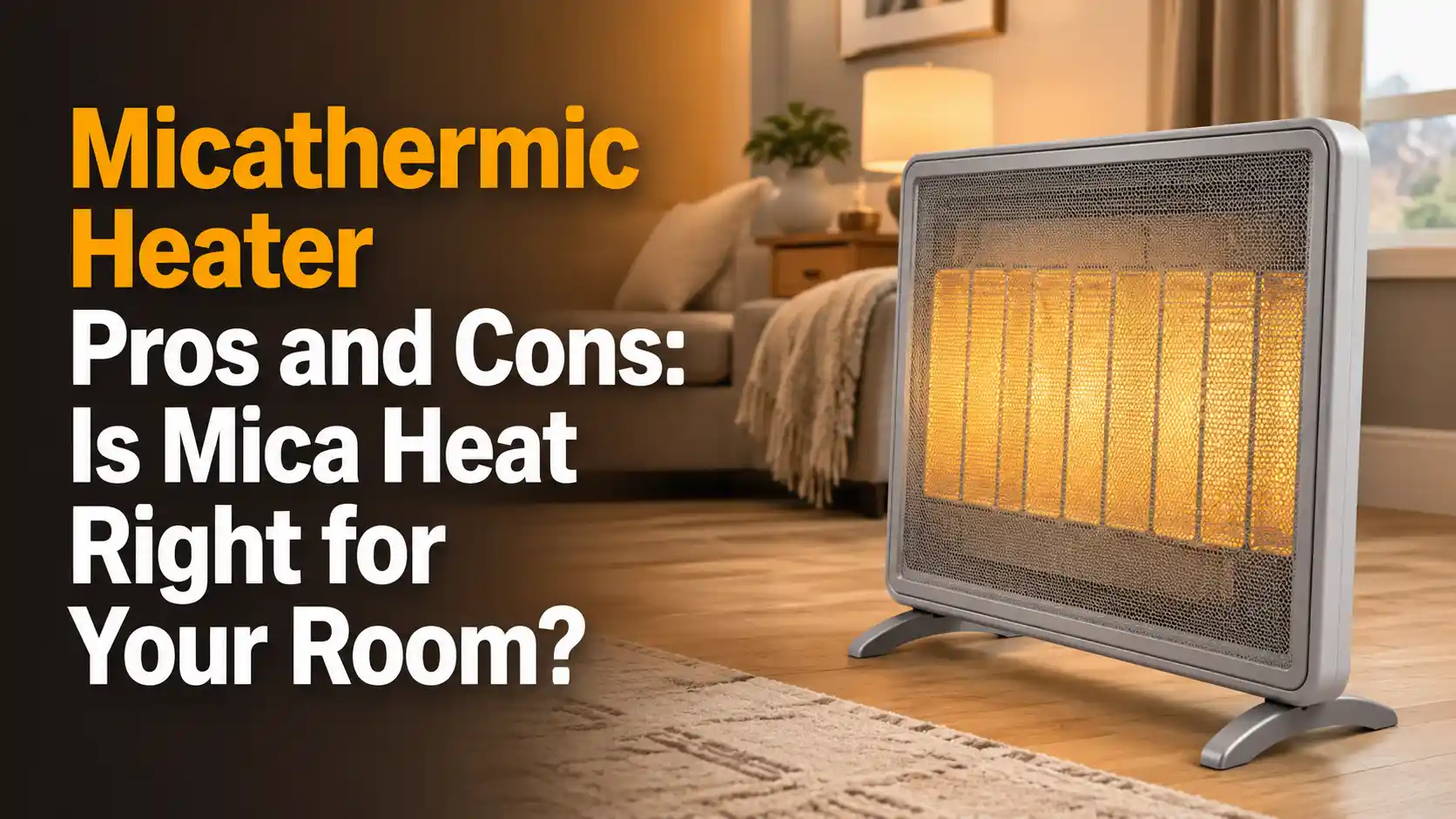


A micathermic heater is a good choice if you want fast, quiet, fanless heat in a bedroom, office, guest room, or small to medium living space. It warms up faster than an oil-filled radiator, runs quieter than a ceramic fan heater, and usually has a slim panel design that fits well in tight rooms.
But mica heat is not perfect for every home. The front panel can get hot. It is not the best choice around young kids or pets unless the heater has strong safety features and enough clearance. It also will not magically use less electricity than other 1,500-watt electric heaters. Like most electric resistance heaters, the energy cost depends mainly on wattage, runtime, thermostat use, and your electricity rate. The U.S. Department of Energy notes that electric resistance heating converts incoming electricity to heat, but it can still be expensive compared with other heating systems.
The real question is not “Are micathermic heaters always better?” It is “Does this type of heat match your room, comfort needs, and safety setup?” This guide breaks down the micathermic heater pros and cons in a practical way so you can decide before buying.
Quick Answer
- A micathermic heater is best for quiet, fast, supplemental heat in small to medium rooms.
- It uses mica-covered heating panels to create both radiant heat and convection heat.
- It is usually silent because most models do not use a fan.
- It is not automatically cheaper to run than a ceramic heater, infrared heater, or oil-filled radiator with the same wattage.
- It may not be ideal for homes with active pets, toddlers, or tight spaces where the hot panel can be touched.
- Choose one with overheat protection, tip-over protection, a thermostat, and a recognized safety certification such as ETL, UL, or CSA.
What Is a Micathermic Heater?
A micathermic heater is a type of electric space heater that uses thin mica-covered panels around the heating element. Mica is a mineral that handles heat well. When the heater turns on, the mica panels heat quickly and spread warmth in two ways.
First, it gives off radiant heat. That means you feel warmth directly when you are near the heater.
Second, it creates convection heat. That means warm air rises from the heater and helps raise the room temperature.
This hybrid style is why micathermic heaters often feel faster than oil-filled radiators and quieter than ceramic fan heaters. TURBRO describes micathermic heating as a mix of far-infrared radiation and convection, while its Arcade HR1500 manual lists the heating element as a silicon crystal and mica composite system.
Micathermic Heater Pros and Cons at a Glance
| Factor | Pros | Cons | What it means for you |
|---|---|---|---|
| Heat speed | Warms up quickly | Heat drops faster after shutoff than oil-filled models | Good for quick comfort, less ideal for long heat retention |
| Noise | Usually fanless and silent | No fan to push air across large rooms | Great for bedrooms, offices, reading rooms, and calls |
| Room fit | Slim and often wall-mountable | Needs open space around the panel | Good for tight rooms if safely placed |
| Energy use | Thermostat can reduce runtime | Same wattage still uses similar electricity while running | Savings depend on zone heating, not heater magic |
| Safety | Many models include tip-over and overheat protection | Front or side panels may get hot | Needs careful placement around kids and pets |
| Air comfort | No fan blowing dust around | Does not filter or clean air | Better for people who dislike fan noise or airflow |
| Portability | Many models are lightweight with handles or wheels | Panel shape can be awkward in cramped rooms | Easy to move, but still needs safe clearance |
How a Micathermic Heater Works
Micathermic heaters are simple. Electricity passes through the heating element. The mica panels heat up. Then the heater spreads warmth through direct radiant heat and natural air movement.

That makes mica heat feel different from three common heater types:
- A ceramic heater uses a heated ceramic element and usually a fan.
- An infrared heater focuses more on warming people and objects directly.
- An oil-filled radiator heats sealed oil inside metal fins, then slowly releases heat.
A micathermic heater sits between these categories. It gives you some direct warmth like an infrared heater, but it also warms room air like a convection heater.
When a Micathermic Heater Makes Sense
A micathermic heater makes the most sense when you want quiet, steady supplemental heat without a fan.
It is especially useful in a home office. You can warm the room you are using without raising the thermostat for the whole house. That is where a space heater can make practical sense, especially for zone heating.
It also works well in a bedroom before sleep, as long as you turn it off before leaving it unattended or follow the specific manufacturer instructions for your model. Many people like mica heat in bedrooms because it is quiet and does not blow air across the room.
It can also be a good option for guest rooms, reading corners, small living rooms, apartments, and rooms where fan noise feels annoying.
When a Micathermic Heater Is Not the Best Choice
A micathermic heater is not the best option for every room.
Skip it if your room is large, open, drafty, or poorly insulated. A 1,500-watt electric room heater can only do so much. It may warm the area around you but struggle to make a big open space feel evenly warm.
It may also be the wrong choice for a nursery, playroom, or pet-heavy area if the heater surface gets hot or can be knocked over. A heater with a cooler exterior, strong tip-over protection, and a stable base may be safer.
You may also prefer a ceramic heater if you want forced airflow and faster circulation across a room. For longer heat after shutoff, an oil-filled radiator may feel better because it keeps releasing heat after the element cycles off.
Micathermic Heater vs Ceramic Heater vs Infrared Heater vs Oil-Filled Radiator
| Heater type | Best for | Heat feel | Noise | Heat retention | Main drawback |
|---|---|---|---|---|---|
| Micathermic heater | Quiet room heating and quick comfort | Direct warmth plus room heat | Usually silent | Low to medium | Hot panel and limited large-room reach |
| Ceramic heater | Fast personal heat and airflow | Warm air blown by fan | Low to noticeable | Low | Fan noise and moving air |
| Infrared heater | Direct warmth for people nearby | Sun-like direct heat | Usually quiet | Low | Less effective when you move away |
| Oil-filled radiator | Slow, steady background warmth | Gentle whole-room heat | Silent | High | Slow warm-up and heavier body |
| Convection panel heater | Even, fanless room heating | Gentle air warming | Silent | Low to medium | Slower feel if no radiant effect |
A micathermic heater is a middle-ground choice. It is faster than many oil-filled radiators, quieter than most ceramic fan heaters, and more room-focused than a small personal infrared heater.
The Main Pros of a Micathermic Heater
1. It Heats Up Quickly
Micathermic heaters heat their panels quickly. You do not have to wait for sealed oil to warm up like you do with an oil-filled radiator.
This matters in a cold office, bedroom, or guest room where you only need heat for a few hours. You turn it on, feel warmth sooner, and let the thermostat cycle once the room is comfortable.
2. It Runs Quietly
Most micathermic heaters do not use a fan. That means no fan hum, no rattling fan blade, and no strong airflow across your face.
This is one of the biggest reasons people choose mica heat over ceramic heaters. It is useful for sleep, video calls, reading, studying, and home offices.
3. It Does Not Blow Dust Around
A fanless heater does not push dust, pet hair, or dry air across the room. That does not mean it cleans the air. It simply means it avoids the airflow problem that some people dislike with fan heaters.
If you are sensitive to fan noise or moving air, mica heat may feel more comfortable.
4. It Often Has a Slim Design
Many micathermic heaters look like thin panels. Some models can stand on wheels, while others can be mounted on a wall.
For example, the De’Longhi HMP1500 is listed by De’Longhi as a 1,500-watt mica panel heater with floor-standing or wall-mountable use, an adjustable thermostat, two heat settings, thermal shutoff, and tip-over protection.
This slim shape is useful when you do not want a bulky heater in the middle of the room.
5. It Can Be Good for Zone Heating
A micathermic space heater can help when one room feels colder than the rest of the home. Instead of heating every room, you heat the room you are actually using.
This is where a portable electric heater may save money. The savings come from heating a smaller zone and using the main thermostat less, not because the mica heater creates free heat.
6. It Can Feel More Natural Than Fan Heat
Because micathermic heaters include radiant heat, the warmth can feel more direct and less drafty than a fan heater. That is helpful when you sit near the heater at a desk or beside a sofa.
It is not the same as a fireplace or full infrared panel, but it gives a pleasant mix of personal warmth and room heat.
The Main Cons of a Micathermic Heater
1. The Surface Can Get Hot
This is the biggest practical downside. Micathermic heaters need hot panels to work. Some models have protective grilles, but the surface may still become hot enough to be uncomfortable or risky to touch.
That does not make the heater unsafe by default. It means placement matters. Keep it away from kids, pets, bedding, curtains, papers, and furniture.
2. It Is Not Automatically Cheaper to Run
A 1,500-watt micathermic heater uses about the same electricity as any other 1,500-watt electric heater while running at full power.
The thermostat can help reduce runtime. The fast warm-up can help you use it for shorter periods. But if you run it on high for 8 hours, it will use a lot of electricity.
3. It May Not Heat Large Open Rooms Well
Micathermic heaters work best in enclosed rooms. In large rooms, open-plan spaces, garages, or drafty areas, the heat may feel weak once you move away from the heater.
For bigger spaces, you may need a stronger whole-room heating strategy, better insulation, or a different heater type.
4. It Does Not Hold Heat Like an Oil-Filled Radiator
An oil-filled radiator takes longer to warm up, but it keeps releasing heat after cycling off. A micathermic heater cools faster.
That makes mica better for quick warmth and oil-filled models better for slow, steady background heat.
5. Product Options Are More Limited
Ceramic heaters are everywhere. Oil-filled radiators are easy to find. Micathermic heaters are more niche.
That means fewer current models, fewer brand choices, and sometimes less consistent availability. Some older popular models may be hard to find new.
6. It Still Needs Strict Space Heater Safety
Micathermic heaters are electric space heaters. They need the same basic safety habits as other portable room heaters.
The National Fire Protection Association recommends keeping space heaters at least 3 feet away from anything that can burn. Fire safety guidance also commonly advises plugging portable heaters directly into a wall outlet, choosing models with overheat protection and tip-over shutoff, and turning heaters off when leaving the room or going to bed.
Best Rooms for a Micathermic Heater
| Room | Is mica heat a good fit? | Why |
|---|---|---|
| Bedroom | Yes, with safety care | Quiet, no fan, comfortable pre-sleep warmth |
| Home office | Yes | Fast, silent zone heat while working |
| Small living room | Yes | Good supplemental heat in an enclosed space |
| Guest room | Yes | Slim, simple, and easy to store |
| Nursery | Usually no | Hot surfaces and portable heater risks need extra caution |
| Bathroom | Usually no | Only use heaters specifically rated for Bathroom use |
| Garage | Usually not | Drafts and poor insulation reduce performance |
| Large open-plan room | Maybe | Works near you, but may not heat the whole space evenly |
What Size Room Can a Micathermic Heater Heat?
Most portable micathermic heaters sold for home use are around 1,500 watts. In a typical enclosed room, that often works best for small to medium spaces.
A practical range is around 100 to 200 square feet, depending on insulation, ceiling height, outdoor temperature, and how warm you want the room to feel. TURBRO recommends its 1,500-watt Arcade HR1500 for rooms under about 160 square feet.
| Room condition | Practical expectation from a 1,500W mica heater |
|---|---|
| Small bedroom, insulated | Usually a good fit |
| Home office, door closed | Usually a good fit |
| Medium room with average insulation | Good for supplemental heat |
| Large room with high ceilings | May feel weak |
| Open-plan space | Not ideal as the only heater |
| Drafty room | Fix drafts first or expect longer runtime |
Is a Micathermic Heater Energy Efficient?
A micathermic heater can be efficient for zone heating, but it is not a magic low-cost heater.
Most electric heaters turn electricity into heat at the point of use. The difference is how the heat feels, how fast it reaches you, and how well the thermostat controls runtime.
A mica heater can help reduce waste if you use it in one occupied room while keeping the central thermostat lower. It can waste money if you run it all day in a large or poorly insulated space.
A simple formula helps:
Watts ÷ 1,000 × hours used × electricity rate = estimated cost
For example, a 1,500-watt heater running for 4 hours uses:
1,500 ÷ 1,000 × 4 = 6 kWh
Multiply 6 kWh by your local electricity rate to estimate the cost.
Micathermic Heater Safety Checklist
Use this checklist before buying or using a mica space heater.
| Safety factor | What to check |
|---|---|
| Safety certification | Look for ETL, UL, or CSA listing where available |
| Overheat protection | The heater should shut off if it overheats |
| Tip-over protection | The heater should shut off if it falls |
| Stable base | Wheels or feet should feel secure |
| Thermostat | Helps prevent constant high-power running |
| Timer | Useful if you forget to turn heaters off |
| Cord condition | No cracks, melting, loose plug, or heat marks |
| Outlet setup | Plug directly into a wall outlet |
| Clearance | Keep at least 3 feet from bedding, curtains, paper, and furniture |
| Manual | Follow the manufacturer’s setup and clearance rules |
Do not plug a space heater into an extension cord or power strip. The CPSC warns that extension cords can overheat and cause fires when overloaded or used with appliances that draw more watts than the cord can handle.
What to Buy If Mica Heat Fits Your Room
This article is mainly an informational guide, so you do not need to buy a micathermic heater just because the technology sounds interesting. But if the pros match your room, these are the types of products worth considering.
De’Longhi HMP1500 Mica Panel Heater
Best for: Quiet bedrooms, offices, and slim wall-friendly setups
Short verdict:
The De’Longhi HMP1500 is one of the better-known mica panel heaters. It makes sense if you want a simple 1,500-watt heater with manual controls, two heat settings, an adjustable thermostat, and the option to use it freestanding or wall mounted. De’Longhi lists thermal shutoff and tip-over switch protection for this model.
Key features:
- 1,500W input power
- Two heat settings
- Adjustable thermostat
- Floor-standing or wall-mountable design
- Thermal shutoff and tip-over switch protection
Pros:
- Quiet fanless operation
- Slim panel design
- Simple controls
- Wall-mount option helps save floor space
Cons:
- No digital display, remote, or advanced timer on the listed model
- Availability can vary, so check current Amazon listings before planning around it
Who should buy it:
Buy this if you want a proven mica panel style heater for a bedroom, office, or medium enclosed room. It is a good fit for people who prefer simple dials over app controls or digital menus.
Who should skip it:
Skip it if you want remote control, Wi-Fi, precise digital temperature settings, or a heater for a large open room.
Reekie 1500W Electric Mica Infrared Convection Panel Heater
Best for: Buyers who want modern controls, timer, and remote operation
Short verdict:
The Reekie mica convection panel heater is a more feature-heavy option. The Amazon listing describes a 1,500-watt mica infrared heater with a smart thermostat, remote control, 24-hour timer, multiple modes, overheat protection, tip-over protection, digital display, and wheels.
Key features:
- 1,500W electric mica infrared heating
- Digital display
- Remote control
- 24-hour timer
- Overheat and tip-over protection
Pros:
- More control features than basic manual models
- Timer is useful for scheduled shutoff
- Remote control is convenient for bedrooms and living rooms
- Wheels help with portability
Cons:
- Smaller review base than some long-running heater brands
- More electronic controls can be less appealing if you prefer simple mechanical dials
Who should buy it:
Buy this if you want mica heat with modern convenience features. It is especially useful if the heater will sit across the room and you want remote control or timer settings.
Who should skip it:
Skip it if you prefer a long-established brand or do not need digital controls.
TURBRO Arcade HR1500 Electric Mica Space Heater
Best for: Small rooms where simple portable mica heat is enough
Short verdict:
The TURBRO Arcade HR1500 is a 1,500-watt electric mica heater designed for supplemental room heat. TURBRO says it has low and high power levels, recommends it for rooms under about 160 square feet, and lists overheating protection plus tip-over auto-off.
Key features:
- 1,000W low setting and 1,500W high setting
- Mechanical adjustable thermostat
- Recommended for rooms under about 160 sq. ft.
- Overheat protection
- Tip-over auto-off
Pros:
- Simple controls
- Good fit for smaller enclosed rooms
- Portable design
- Safety shutoff features listed by manufacturer
Cons:
- No remote control or digital display listed in the basic HR1500 information
- Not ideal for large rooms
Who should buy it:
Buy this if you want a simple portable mica heater for a small office, bedroom, or living area. It is a practical choice when you care more about quiet heat than smart features.
Who should skip it:
Skip it if you need precise digital temperature control, remote operation, or coverage for a large room.
Buying Guide: How to Choose a Micathermic Heater
Start With Room Size
A mica heater works best in an enclosed room. Before buying, measure the room and think about insulation.
For a small bedroom or office, a 1,500W heater may be enough. For a big open living space, it may only warm the area near the heater.
Choose the Right Control Style
Manual controls are simple and reliable. Digital controls give you more precision.
Choose manual dials if you want easy operation. Choose a digital thermostat and timer if you want better scheduling and comfort control.
Look for Real Safety Features
Do not buy a heater just because it says “safe” in the title. Look for specific features.
At minimum, choose a model with overheat protection and tip-over protection. Also look for ETL, UL, or CSA certification when available.
Decide If You Need a Timer
A timer is useful in bedrooms and offices. It lets the heater shut off after a set time.
This is especially helpful if you use the heater before sleep or during work hours.
Check Portability
If you move the heater often, look for wheels, a handle, and a stable base.
If you plan to keep it in one room, a wall-mountable panel design may be cleaner.
Think About Kids and Pets
If a child or pet can touch the heater, be careful. Micathermic heaters may have hot surfaces.
Use a stable model, keep it out of reach, and never place it near bedding, curtains, toys, or pet beds.
Avoid Bathroom Use Unless the Heater Is Rated for It
Do not use a regular micathermic heater in a bathroom. Water and portable electric heaters are a dangerous mix.
Only use a bathroom heater that is clearly designed and rated for bathroom use, and follow the manual exactly.
Common Mistakes to Avoid
Buying Only by Wattage
Most full-size portable electric heaters are 1,500 watts. That does not mean they feel the same.
A micathermic heater feels different from a ceramic fan heater because it spreads heat differently. Match the heater type to the room, not just the wattage.
Expecting It to Heat the Whole House
A micathermic heater is a room heater. It is not a replacement for central heating, a heat pump, or a whole-home system.
Use it for supplemental heat in the space you occupy.
Placing It Too Close to Furniture
The panel needs open space. If it is too close to a sofa, curtain, bed, or desk, heat can build up.
Follow the manual and keep safe clearance around the heater.
Running It on High All Day
A 1,500W heater can add noticeable cost if it runs for hours every day.
Use the thermostat, close doors, seal drafts, and turn it off when the room is comfortable.
Ignoring the Plug and Outlet
A hot plug, loose outlet, flickering light, burning smell, or discolored wall plate is a warning sign.
Stop using the heater and have the outlet checked. Do not use unsafe workarounds.
Final Verdict: Is Mica Heat Right for Your Room?
A micathermic heater is worth considering if you want fast, quiet, fanless heat for a bedroom, office, guest room, or small to medium living space. It is especially useful when you want supplemental warmth without the noise and airflow of a ceramic heater.
It is not the best choice for every room. Choose something else if you need to heat a large open area, want strong air circulation, need long heat retention after shutoff, or have a room where kids or pets may touch the heater.
The best way to think about micathermic heater pros and cons is simple. Mica heat is quiet, quick, and slim. But it still uses standard electric heater wattage, needs safe clearance, and works best as a room-by-room comfort tool.
FAQs
Are micathermic heaters good for bedrooms?
Yes, micathermic heaters can be good for bedrooms because they are usually quiet and fanless. Use them safely, keep them away from bedding and curtains, and turn them off when leaving the room or going to sleep unless your specific model’s manual says otherwise.
Do micathermic heaters use less electricity?
Not automatically. A 1,500W micathermic heater uses similar electricity to other 1,500W electric heaters while running at full power. It may cost less only if the thermostat reduces runtime or you use it for zone heating instead of heating the whole home.
Is a micathermic heater better than a ceramic heater?
A micathermic heater is better if you want quiet, fanless heat. A ceramic heater is better if you want forced warm air and faster circulation across a room. For bedrooms and offices, mica heat often feels more comfortable.
Are micathermic heaters safe around pets?
They can be safe when used correctly, but they are not always ideal around active pets. The panel can get hot, and the heater may be bumped. Choose a stable model with tip-over protection, keep it away from pet beds, and never leave it where a pet can knock it over.
Can a micathermic heater heat a large room?
Usually not as the only heat source. A 1,500W micathermic heater works best in small to medium enclosed rooms. In a large open room, it may provide comfort near the heater but struggle to warm the whole space evenly.
Do micathermic heaters dry out the air?
A micathermic heater does not add or remove moisture from the air. It may feel less drying than a fan heater because it does not blow warm air across your skin, but the room’s relative humidity can still drop as temperature rises.
Can I plug a micathermic heater into an extension cord?
No. Plug the heater directly into a wall outlet. Extension cords and power strips can overheat when used with high-wattage appliances like space heaters.
How long do micathermic heaters last?
It depends on build quality, usage, dust buildup, storage, and electrical conditions. Choose a reputable model, clean vents as instructed, avoid overheating, and stop using the heater if the cord, plug, controls, or panel show damage.

